

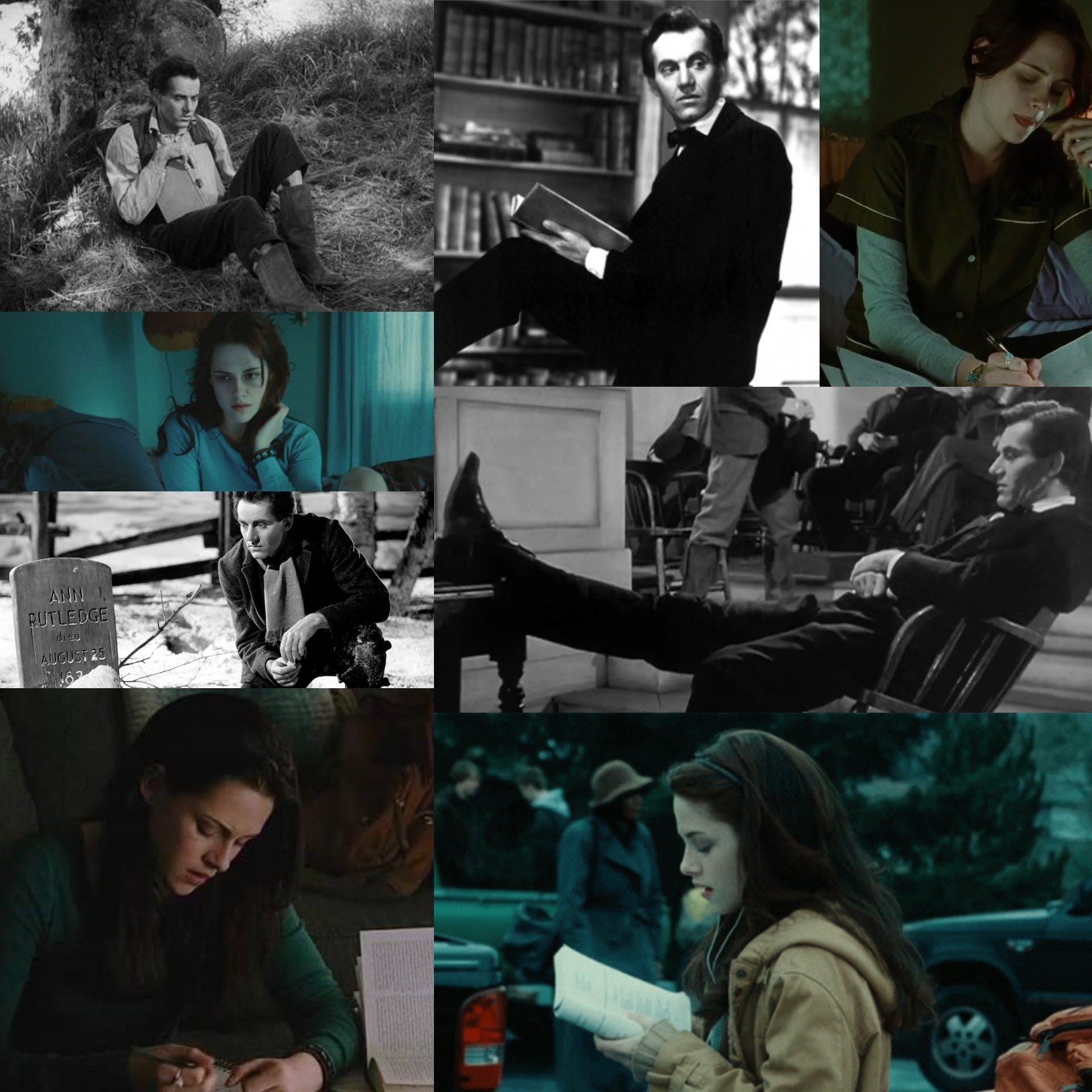
Danny: I enjoyed your recent book report, Some Thoughts About Twilight, very much:
Two Sundays ago, San Francisco being much befogged, and my brain, somewhat, likewise, I thought I would read the copy of Stephenie Meyer’s Twilight that my woke PhD student friend had lent me the day before, having never done this at any other point in my life. Interesting read! The first thing that stuck out to me was that after a perfunctory flash forward, in which nothing much interesting is revealed about our narrator (Bella) except that one day she will be in a Situation, we get to the good stuff: this freak LOVES Phoenix, Arizona, as well as . . . canonical literature? From whatever afterlife they put literary scholars in, Wayne C. Booth is surely sobbing tears of joy at this masterclass in unreliable narrator establishment — surgical, ruthless.
Well, after that, we get to high school, where there’s a guy, Edward, who is lowkey kind of different, not like the other boys at the high school, or even very much like the Edward from the movie Twilight, which I have seen, some years ago: I remember thinking at the time that any admiration for this guy at the high school who is not like the other boys at the high school suggested some deep spiritual rot at the heart of American empire, as he is creepy, and I didn’t like him, but in the book things are different: for one, we’re in Bella’s head, and she thinks a lot (this is not so much a feature of the movie); for another, while my main memory of the movie is that Edward is staring at Bella in class and deathgripping the desk as if it is the only thing standing between him and a rapacious, one might even say a well-nigh murderous, lust, in the book he is a little more British, and they understate — interesting, I thought, as I’ve just been introduced to Jacob, the also charming, but this time indigenous boy who is into cars and dopey smiles and so forth, and while I never read Twilight, I was somewhat aware that each of these boys had Teams, and that Bella would soon find herself in another Situation . . . tea, I thought, familiarly, but I was nevertheless experiencing this text as if it had never been read — no one told me it would be allegorical!
Yes, what else is one to think here except that Bella is meant to be a prototypical American novelist, caught between the canonical, Anglophone tradition — charming, sometimes, but also anachronistic, and more than anything, perpetually undead — and the indigenous culture of the land upon which she lives, a crossroads she sees reflected anytime she looks in the mirror of the postcolonial writer, who faces this very same set of paths, only, you know, reflected.
This kicked off a goofy conversation about humidity in the Twilight series:
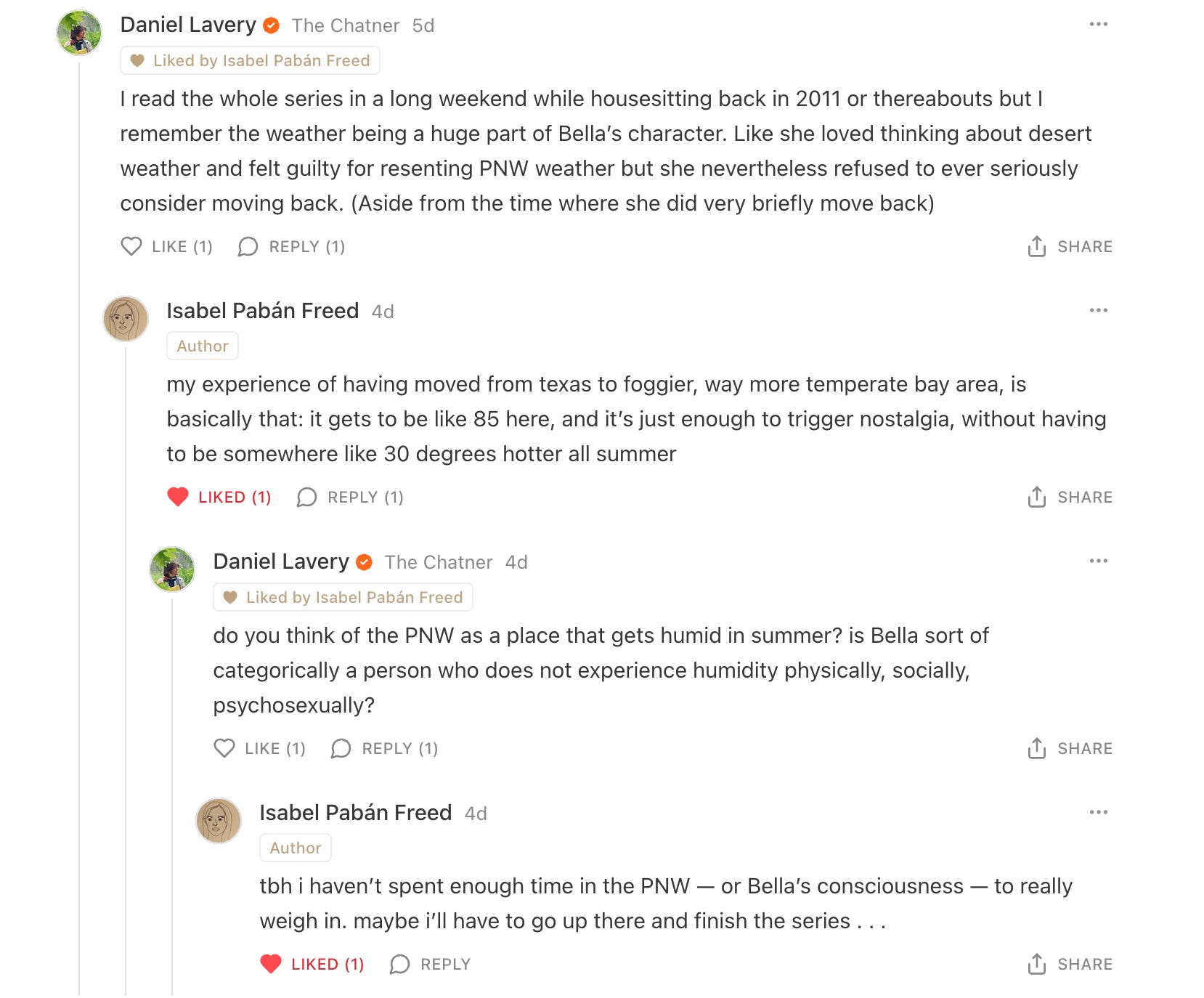
There’s a conversation Bella has with her father after he picks her up from the airport towards the beginning of the book that I really love, right before she goes into a description of the characteristic greenness of the Pacific Northwest landscape:
“We exchanged a few more comments on the weather, which was wet, and that was pretty much it for conversation. We stared out the windows. It was probably beautiful or something.”
I think of Bella as a character who is incredibly humid, spiritually speaking, because she’s so ready to be saturated and slowed down. She seems born to be waterlogged and subject to microscopic influence.
