

My next novel, Meeting New People, is coming out June 2nd. If you care to preorder it this week, Barnes & Noble will be offering a 25% off sale between Tuesday, March 24th to Thursday, March 26th.
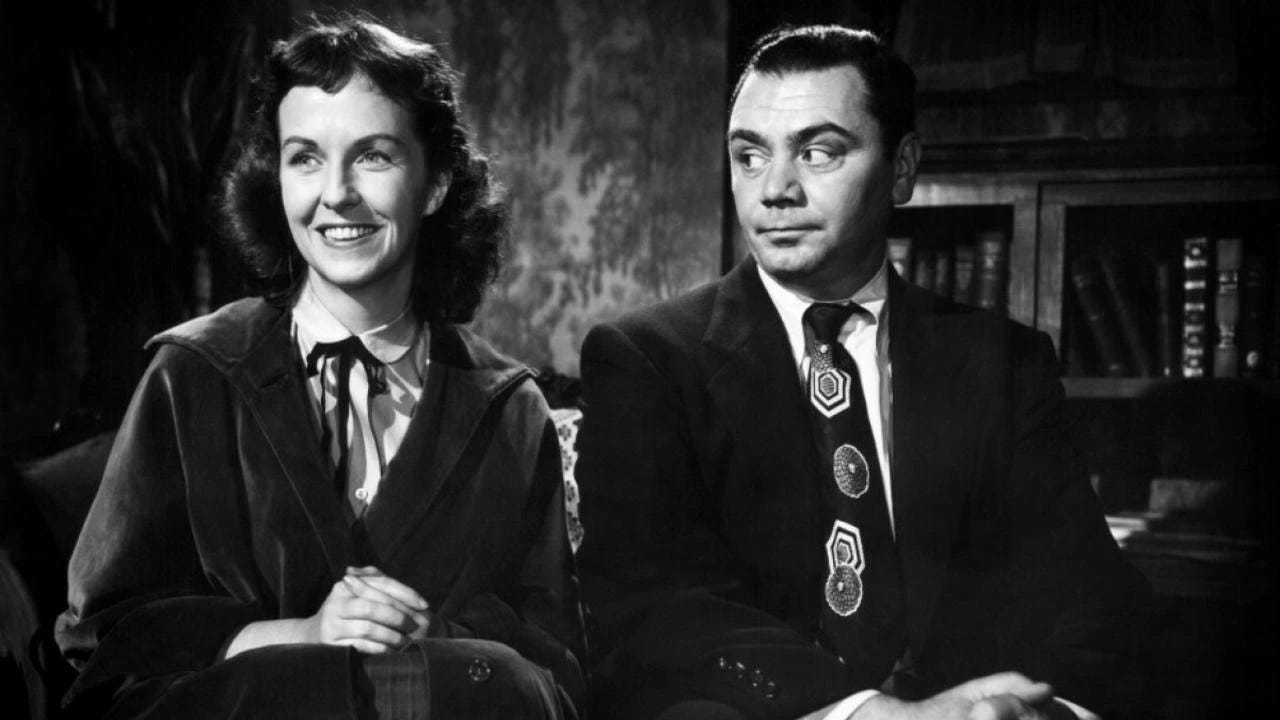
People will sometimes try to recommend Marty in light of the incel movement or the “male loneliness epidemic,” but you can safely ignore that sort of talk. Nor should you believe anyone who describes the movie with any of the following words: sentimental, universal, simple, little, or humble. It’s a movie about how the GI Bill remembered to provide servicemen with college degrees, steady employment, and a home, but forgot to throw a wife into the bargain during the 1950s, a decade that acted like a marriage-producing machine, where your neighbors could lawfully kill and eat you in the streets if you stayed single too long.
Ernest Borgnine plays Marty, a thirty-four-year-old Italian-American butcher living in the Bronx, the only unmarried Italian-American man left in the world, who has ten thousand brothers and sisters, each of them more married than the last. Imagine an Omelas child who is allowed to leave the house once a day in order to slice lamb chops and experience sexual humiliation and you’ll have a pretty good idea of the character. Imagine a world where marriage exists primarily as a form of conversational currency that will prevent people from screaming at you in a butcher shop, and you’ll have a pretty good idea of the moral universe this character lives in.1
You don’t get either Moonstruck or When Harry Met Sally… without Marty, incidentally. When Harry Met Sally shares Marty’s preoccupation with New Year’s Eve as a bellwether of the safety the couple-form provides, and Moonstruck manages to pull off the same trick of making a Catholic Italian-American from a traditional family getting engaged seem like the most shocking and subversive act imaginable, with the same remarkable neatness.
In the opening scene, one of Marty’s middle-aged customers, Mrs. Fusari, asks him which of his brothers got married the past weekend. During his monologue she occasionally interrupts him to heckle or correct in an increasingly aggrieved tone.
“No, that’s my other brother, Freddie,” he says. “My other brother Freddie, he’s been married four years already. He lives down on Webb Avenue. The one who got married Sunday, that was my little brother, Nickie…No, that’s my sister Margaret’s husband, Frank. My sister Margaret, she’s married to the insurance salesman, and my sister Rose, she married a contractor. They moved to Detroit last year. And my other sister Frances, she got married about two and a half years ago in Saint John’s Church on Kingsbridge Avenue. Oh, that was a big affair. Well, let’s see now, that’ll be about a dollar-seventy-nine. How’s that with you?”
“When you gonna get married, Marty?” Mrs. Fusari says in response. “You should be ashamed of yourself. All your brothers and sisters, they all younger than you, they married and they got children.”
People will sometimes refer to Borgnine’s Marty as “gentle” or “amiable,” but this is not true either.2 His affability is paper-thin and exaggeratedly wounded. He is not a cheerful man; scratch him and he will scream. He lives in an impossible world. His friends want to meet women, not keep them, and his mother, Mrs. Pilletti, wants him to get married right up until he meets a viable candidate, at which point she sours on them both.
About a third of the way through the movie Marty does meet Clara Snyder at the Stardust Ballroom, it is because her date has approached him in the stag line and offers him five bucks to pretend to be an old army buddy and take “a dog” off his hands. The stag line at the Stardust is a wretched place to be: a row of dateless, danceless men all waiting their turn to work up their nerves or to sweat out a rejection. The “dog” in question is played by Betsy Blair, who has the face of a saint, and spends most of the movie either weeping or listening radiantly. Blair often plays Clara as if she were playing a blind woman, turning her face in expectant radiance towards Marty without making direct eye contact. She wears a terrible little Peter Pan collar with a bolo tie, too, which is how you know she does not expect to ever be loved, and her splendid long face makes a wonderful counterpoint to Borgnine’s splendid wide face.
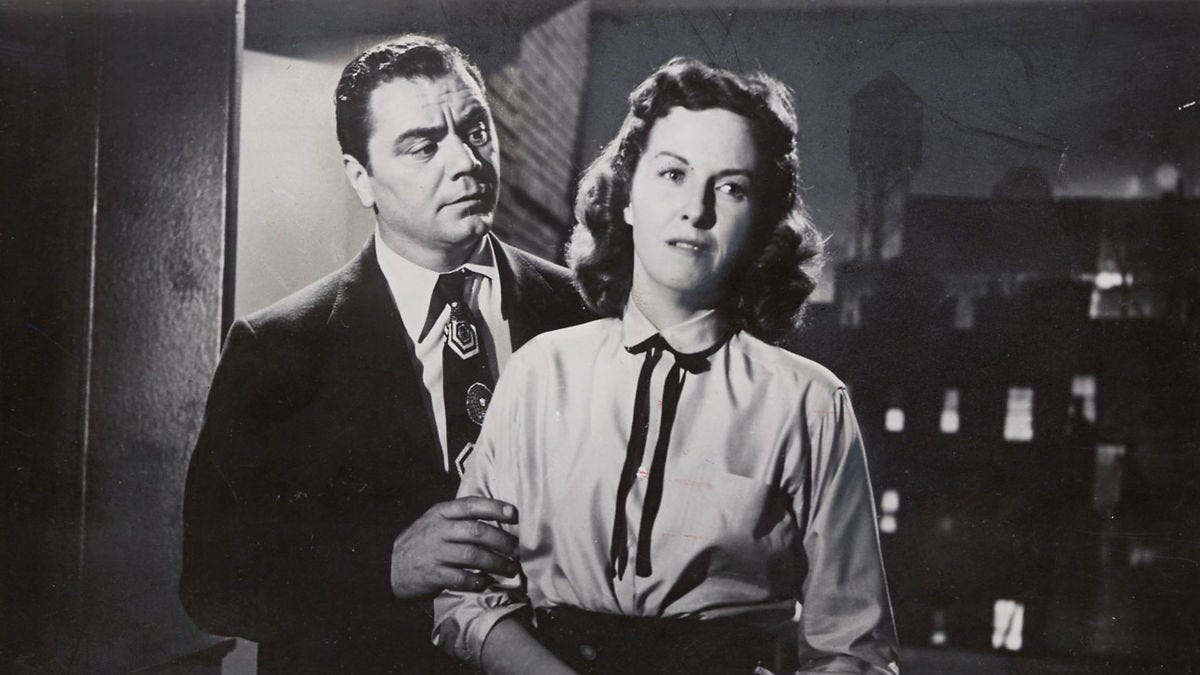
Everybody will tell you to get married but nobody really wants to let you do it on your own terms. This is where the Omelas complex comes back in; no one is happy when two plain wallflowers find one another. Marriage is for the young and the beautiful. No one is excited for Marty to meet someone, if the someone he’s met is just another Marty. When Marty realizes this, his despair is complete.
Everyone around him is cruel; so excuse him when he’s cruel.
He makes his verbal restraint (withholding is often a better term) conspicuous at every opportunity, and only drops his passive-aggression for the occasional burst of aggression. He is polite only to remind others around him where they have failed to be polite, to highlight their lapse in standards, and the lapses are frequent and deranged. Mrs. Fusari says “What’s the matter with you?” and “You oughta be ashamed” at least twice more before completing her purchase; the very next customer, Mrs. Canduso, asks after the wedding and immediately follows it with “You oughta be ashamed,” while Marty is wrapping up a four-pound pullet for her.
Marty is as far above his surroundings as an Austen heroine, and like an Austen heroine knows his continued existence rests upon resisting the values of his most beloved friends and relations.
Every woman Marty knows wants him to get married, and every man Marty knows wants him to waste his time endlessly, like the Terrible Trivium from The Phantom Tollbooth. His friends hang out in bars and the street and back porches reading newspapers, magazines, dime store novels, having pointless, sterile, repetitive, masturbatory (sometimes literally) conversations. A few illustrative pieces of dialogue:
“What happened?”
“The Yanks took two.”
“Any homers?” [No answer.]
and:
[Reading a dirty magazine in public] “They shouldn’t sell magazines like this on a public newsstand.”
Worst of all is a conversation between Marty and his wretched friends that takes place right before the climactic phone call, as he sits sweating in a punishing vision of the sort of future he can look forward to in their company:
Joe: “I always figure a guy oughta marry a girl who’s twenty years younger than he is, so that when he’s forty, his wife is a real nice-lookin’ doll.”
Leo: “That means he’d have to marry the girl when she was one year old.”
Joe: “I never thought of that.”
There’s a sense throughout the movie that Marty becomes increasingly aware that he is living in Hell. It was perhaps more than a little narcissistic of me to respond in this way, but I could not help but take it personal, upon learning that both my brother and my father were pedophiles a little more than a year after I had decided to make a go out of living as a man. Certainly I had not decided to transition solely out of admiration for my male relatives, but the information nevertheless threw a dampener over the scheme for a time. The walls are closing in on Marty. The only train leaving the station is marriage and the only other passenger is Clara.
It’s not a sweet movie, is what I mean. But there’s something bracing and even refreshing about watching people leave the house and visit a lot of “third spaces” and still experience non-stop loneliness, brutality, one-upmanship, and defeated bids for intimacy. The screenwriter Paddy Chayefsky came up with the idea after going to a dance at the “Friendship Club” (!) one night where he saw a sign reading “Girls, Dance With the Man Who Asks You. Men Have Feelings, Too” (!!). That’s exactly the sort of leverage Marty uses on Clara, too; his insecurity and self-pity are so massive, so lit up in neon, so demanding of attention, that there is little room for hers.
“You can’t just walk off on a girl like that,” Marty says to Clara’s date, appalled at the waste. But he’s fascinated by the effects of cruelty on Clara, and watches hungrily as some other stag is willing to take the five bucks and lie to her. It’s a new sort of cuckoldry, where rejection takes the place of sex, and Marty gets to watch it all from the best seat in the house. He sees her unwanted first and crying second; that’s how he knows she’s the girl for him, because of her exquisite sensitivity to deception and cruelty. He sees in Clara the possibility of someone who will recognize his own suffering, and their union a reward for their mutual distress — hers for necer complaining, his for incessant grumbling. She endures distress in silent tears, like the little mermaid, while he endures distress loudly, like the prophet Jonah, or saint Martha, or Christ cursing the fig tree.3 He never shuts up once on their date. Occasionally he will curse himself for talking to me, and promises to stop talking, but he can’t, and she does not seem to mind. His loneliness has always been accompanied by plenty of talk, and he’s used to it; her loneliness, we suspect, has involved a great deal of silence, and she is relieved to be bathed in chatter.
Incidentally, Marty frequently refers to both himself and Clara as “dogs,” not because he thinks she’s ugly but because everyone else claims to. Which is all well and good, communally-mediated attractiveness being an important element of the story, but it makes it all the stranger that no one acknowledges the fact that his sister-in-law Virginia, who plays an important role in the movie’s subplot, is beautiful almost beyond the point of reason.
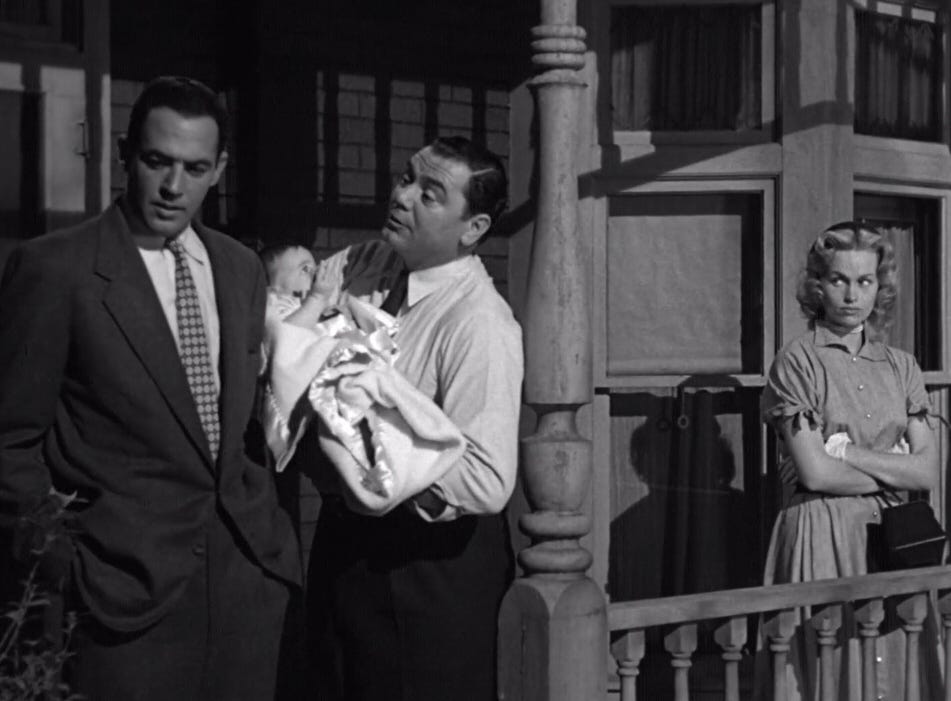
Frankly, 20-30% of the movie’s dialogue should be given over to this woman’s beauty. People should be talking about it all the time. They should be talking to her like Jon Hamm in 30 Rock’s “The Bubble” episode, but everyone just wants to talk about how ugly Marty and Clara are, as if having an angel’s face were an unremarkable fact of everyday life.
Virginia is married to Marty’s cousin Thomas. Her mother-in-law, Marty’s aunt Catherine, lives with the two of them and their new baby, and Virginia and Catherine fight all the time. Both Virginia and Thomas are desperate for Marty and his mother to invite Catherine to live with him, although as soon as the tradeoff is made, Virginia and Thomas turn on each other, and there is no indication in the script that their lives will improve as a result of being left to their own devices.
Catherine and Mrs. Pilletti have a Death of A Salesman sort of conversation, poignant and embittered by turns, about being forced into early retirement as wives and mothers: “I’m only fifty-six years old,” Catherine says to her sister before begrudgingly accepting her invitation to move in together. “What am I going to do with myself? I have strength in my hands. I want to cook. I want to clean. I want to make dinner for my children. Am I an old dog to lie in front of the fire til my eyes close? These are the terrible years.”
Mrs. Pilletti offers sisterly consolation, tenderness, and understanding in return: “Catherine, you are very dear to me. We have cried many times together. When my husband died, I would have gone insane if it were not for you. I ask you to come to my house, because I can make you happy. Please come to my house.” It makes no dent, it makes no difference. Catherine is not consoled one whit.
Speaking of things you can ignore! Don’t let anybody try to tell you that this movie is about how the midcentury ideal of the nuclear family pushed out older ideals of extended kinship or raising a child with a village, either. I’m sure it did, but Aunt Catherine doesn’t want to be part of a village. She wants to be a vampire king. She exaggerates Virginia’s gestures as potential violence — “That girl was shaking her hand at the the baby. I said, ‘You brute! Don’t you strike that baby! That’s my son’s baby!’” — to which her sister tries to remind her, “Well, it’s her baby, too, you know.”
“That’s my son Thomas’ baby,” Catherine repeats.
“Well, it ain’t your baby,” Mrs. Pilletti says.
An in-law unit would not solve Aunt Catherine’s problems, is what I mean, when what she wants is to kill and eat her daughter-in-law, and never stand aside for anyone. Wonderfully, the Catherine-and-Mrs. Pilletti storyline is never resolved in the slightest. There is not even a gesture towards resolution. Catherine is unhappy, and infects Mrs. Pilletti with her unhappiness; Virginia and Thomas are not cured of their unhappiness by expelling her from their home. Their scenes simply stop showing up on the screen.
Mrs. Pilletti, who had been so eager for Marty to meet a nice girl, who had been so tentatively warm to Clara when they met briefly in the kitchen, becomes nervous and hateful as soon as Catherine suggests that she too will be crowded out when her last son gets married: “She don’t look Italian to me,” she tells Marty the day after his date. “I don’t like her. Don’t bring her to the house no more — I don’t know. She don’t look Italian to me.”
No one wants Marty to call Clara the day after their date except for Marty. His furious announcement that he likes her despite the general disapproval of his neighborhood is at least an avowal of pleasure (“I had a good time last night. I’m gonna have a good time tonight”):
“Miserable and lonely! Miserable and lonely and stupid! What am I, crazy or something? I got something good here! What am I hanging around with you guys for?…You don’t like her. My mother don’t like her. She’s a dog, and I’m a fat, ugly little man. All I know is I had a good time last night. I’m gonna have a good time tonight. If we have enough good times together, I’m gonna go down on my knees and beg that girl to marry me. If we make a party again this New Year’s, I gotta date for the party. You don’t like her, that’s too bad.”
That he does make the call feels hugely significant. I had been prepared to find the sentiment of Marty grating, but I was on the edge of my seat; it felt as though I was watching a single soul escape Hell at the very last possible second, and for the first time I understood Luke 15:7, “I say unto you that likewise more joy shall be in Heaven over one sinner that repenteth, than over ninety and nine just persons who need no repentance.”
But it’s important, I think, that our final glimpse of Clara is at home, alone on the couch with her parents, watching television and weeping, because Marty did not call when he said he would, was not willing to avow the pleasure he took from her company until after he had broken the only promise he’s made to her.
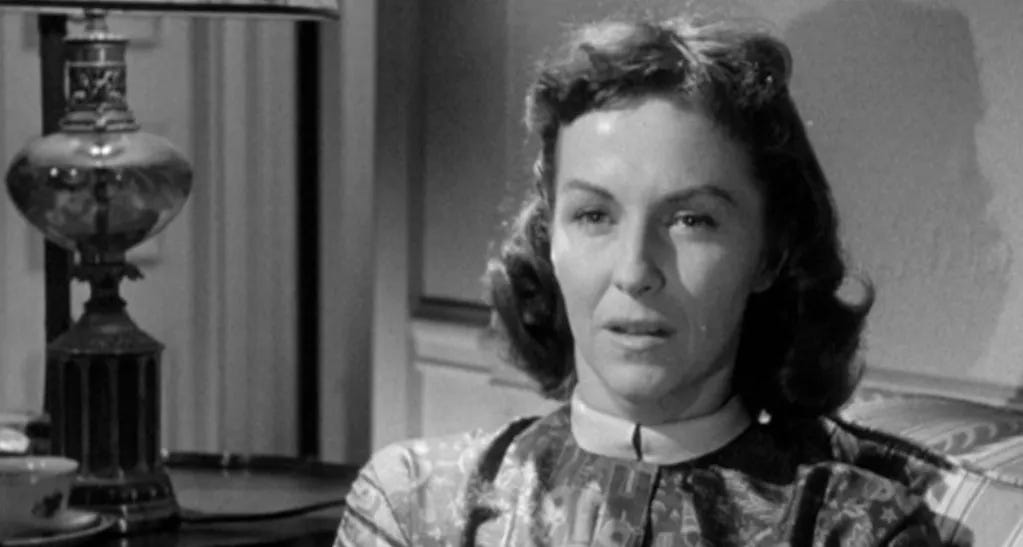
It’s fitting that, aside from the conversations between Aunt Catherine and Mrs. Pilletti, the only other time we see two women discussing marriage in Marty it’s between two unnamed Irish women drinking at Marty’s regular bar. They’re discussing a mutual acquaintance who keeps having children, despite her doctor’s admonition that more children will kill her:
“Well, last week Tuesday, she gave birth to the baby in St. Elizabeth’s Hospital,” the first woman says, “a big healthy boy of nine pounds.”
“Oh, that’s nice. So the doctor was wrong, wasn’t he?” says the other.
“Oh, no. She died right in the hospital.”
“Oh, that’s a sad story. And her husband is that little fellow, works in Peter Reeves?”
“That’s the one.”
“Oh, that’s a sad story.”
Clara leaves the movie the same way she entered it: weeping, in a high collar. Marriage is no good and will kill you, but the alternative is worse.
Marty at least gets to experience the pleasure of doling out cruelty rather than absorbing it before the credits roll. Just as he slides into the phone booth to call Clara up, utterly secure in the knowledge that she will forgive him, he turns to his best friend and tormenter Angie and repeats what Mrs. Fusari told him at the beginning of the film:
When you gonna get married, Angie? Aren’t you ashamed of yourself? You’re thirty-three years old. All your kid brothers are married. You oughta be ashamed of yourself.
Then he closes the door to the phone booth, decisively, like Al Neri shutting Kay out of the room at the end of the Godfather. It’s a wonderful, vicious little film, and I felt as though I had been suffocated by the end of it.
It’s like a reverse Company, if no one in Company wanted Bobby to get married after all. Perhaps that’s just Company; I’m not sure anyone in Company wants Bobby to get married as much as they want him to say he wants to get married.
Though it is true that his face is radiantly amiable. Ernest Borgnine’s face is a wonder. He was born to play the Spirit of Christmas Present. He looks like if Edward G. Robinson had been filled with joie de vivre. The light in his eyes makes me want to cry, and he has the same gap between his two front teeth as the Wife of Bath. You could not say he was a good-looking man, but he is wonderful to look at all the same.
In the tradition of holy complaint, like Psalm 142:2: “I pour out my complaints before him; I tell my troubles before him.”
Per your footnote about Ernest Borgnine's face: it feels important to share here that I met him when I was a teenager, and his face in person was still *dazzling* in just the way you describe. A beautifully compelling man to look at, and charming as anything, even to a pink-haired 16 yr old who barely knew who he was.
There exists — or existed — a musical based on this movie, by Charles Strouse and Lee Adams (the team behind Bye Bye Birdie and Annie and a few other shows.) As far as I know, it played Boston for a few months in about 2003, got a little buzz but never quite managed a Broadway transfer, and has never been performed again. It was a very odd thing, partly because it changed the general crankiness of all the background characters into Lovable Curmudgeons and Happy Dancing Villagers, which is just a very different vibe. You just can’t be cranky in quite the same way while singing, unless you’re in Sondheim. So you had all these festive chorus numbers, with everyone dancing while they buy their meat, framing the sort of limpid glowing sadness of John C Reilly, fully in his Mr Cellophane era, as Marty, longing for love in approximately the same way a cartoon mouse longs for cheese. Also his accent was mildly hokey and the music deeply and painfully sentimental.