

In a similar vein: Things people say in old movies to prevent another person from discussing their feelings for even a second.
Don’t talk like that
Say, don’t talk like that
Why, don’t talk like that
You just leave that alone now
What you need is a drink
What you need is a stiff drink
What you need is a couple of drinks
I know what you need – a drink
How about a cup of coffee?
I know what’ll put you right –
Hey, now – not another word of that!
You’ve got too much sense to talk like this
Now what put an idea like that into your head?
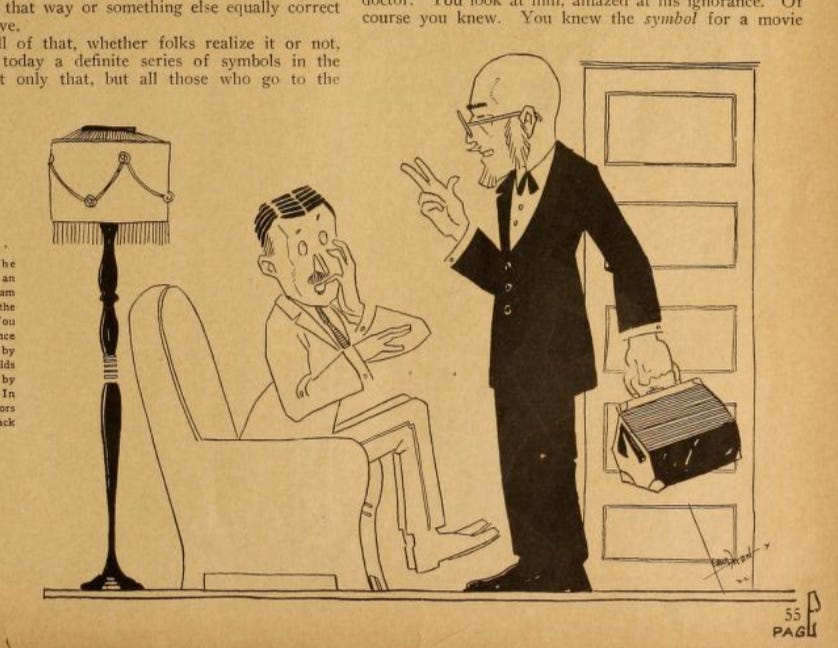
Part of the pleasure of the family doctor’s appearance in middlebrow midcentury literature — the black bag, the easy confidence, the careless acceptance of the deference of others, the free hand with the prescription pad, the home visit — is how much free time they seem to have, and what genuine pleasure they seem to take in explaining things. I’m sure there are doctors who spend a lot of time explaining things nowadays, but I never run into them. Everyone I know, unless they are very ill, spends most of their medically-appointed time with NPs and CNAs and medtechs and pharmacists, usually on the other end of a phone tree or a proprietary app, and they don’t have time to explain much of anything.
But there did used to be doctors, quite a lot of them, and they used to have so much free time they could turn up at the end of an Alfred Hitchcock movie to explain what murder is. And if you’ve ever spent time with a popular midcentury paperback novel, you know that a doctor’s two favorite things to do are give people pills to calm them down and tell young people whose aunts have just been murdered that they ought to get married.
The joke is not that doctors used to say foolish things confidently and don’t now. We all say the most ridiculous things about the body and medicine all the time; it just takes a little longer to figure out what’s ridiculous so we’re always catching up to ourselves.
“The best prescription I can offer him is peace and quiet. As little movement as possible. If he could see a horse from his window from time to time — a peaceful, quiet sort of horse, you understand, not a nervous one, certainly not a thoroughbred — that would be even better.”
“Have you still got those yellow pills I gave you?”
“Your father’s heart is weak. You must never tell him this; it would weaken his heart.”
“The best prescription I can offer him is someone who believes he’s going to get better.”
“Say, you ought to be in bed!”
“Where on earth did you get those pills from? The only pills you ought to be taking are the pills I give you. I’m really very annoyed about this sort of thing, Miss Frances, and I’ve got half a mind to stop writing you prescriptions for pills unless you can promise me frankly that you’ll stop mixing them together like this. Do I have your word?”
“Have you still got those green pills I gave you?”
“I don’t want to worry you any further with a lot of technical talk. The worst thing for this sort of case is discussion.”
“There’s nothing wrong with you. If you need a further prescription than that, I’ll go so far as to say you ought to be married. Everybody ought to be married.”
“[Examining a body] Yes, it might have been poison. But I still say he was simply upset.”
“Oh, there’s nothing at all wrong with his mind, except that he believes there’s something wrong with it.”
“You seem awfully tired. Have you still got any of those blue pills I gave you?”
“There’s no better prescription than a little fresh air and hard work.” [Becoming suddenly daring] “Especially if it’s in your company, Miss Millner.”
“The worst thing you could do for her right now is to give her what she wants.”
“Say, you ought to get back in bed.”
“The best thing I can do for you in this case is to help you laugh it off.”
“My diagnosis is this: You’re worn out. You’re not cut out for city living. You ought to be nearer to a ranch, speaking as a medical man.”
“I don’t see how someone could have gotten their hands on poison — unless they happened to steal some out of my car, which I leave unlocked and running outside of my office every afternoon for an hour or so while I take my lunch. Of course I carry a valise of poisons with me as a general rule, but if that’s a crime, I’m afraid you’ll have to lock up every M.D. in the country.”
“You’re not out of pills, are you?”
“The best prescription I can give the two of you is this: Get married.”
[References include Malice Aforethought, Anthony Berkeley Cox; Beebo Brinker, Ann Bannon; Patricia Highsmith; The Group, Mary McCarthy; Valley of the Dolls, Jacqueline Susann; Dark Victory, George Brewer Jr.; The Man in the Brown Suit, Agatha Christie. If you haven’t yet read Malice Aforethought, you really should, and if you already have, then you ought to read The 12.30 from Croydon by Freeman Wills Crofts.]
[Image via]

For what it's worth, a modern-day doctor advised me to move to Canada for the weather and primarily eat stew. She may have a point, but I lack the means (or appropriate external narrative intervention) to follow her advice.
Plus they're often making house calls! Tangential: Have you read Stephen Potter's "Upmanship" books? The section on "Doctorship" (in "One-Upmanship") is one of my favorite things in the book:
"...in the bedroom, the brisk type of MD-man is able to suggest by his manner not only that Patient's room is surprisingly disordered, but that he, the Doctor, goes in for a more up-to-date type of pajamas:
LAYMAN: Thank you, Doctor. I was coming home rather late last night from the House of Commons...
MD-MAN: Thank you...now if you'll just let me put these...hair brushes and things off the bed for you...
LAYMAN: I was coming home rather late. Army Act, really --
MD-MAN: Now just undo the top button of your shirt or whatever it is you're wearing..."