

Previously in this series: Three parents discuss children’s books.
DANNY: And I like Boo and Baa, because I love those little routines or escapades, especially ones that don’t have a moral, or the moral is no stronger than “Well, you had an interesting day.” The only moralizing book of his I like is Strega Nona, unsurprisingly, because the moralizing involves punishment. I don’t like anything along the lines of “It’s okay to have big feelings” or “Here are three things you can do to calm down when you’re mad.”
GRACE: “It was better in the olden days.”
DANNY: Look, I don’t object to the idea of helping a toddler learn how to calm down, I just dont like the idea of locating all that moral messaging while we read. I find it cloying in a book.
LILY: The thing that’s agreeable about Strega Nona is it’s not just Big Anthony who doesn’t listen, but the townspeople also seem to be foolish. Even though they’re the ones who are mad at Big Anthony, they don’t have the moral advantage, they’re too quick to jump to conclusions and point blame.
DANNY: And the punishment still includes reincorporation. He has to eat all the pasta in town, but at the end of the day he keeps his job and gets to sleep next to the goats. It’s not only punishment.
The Pages of Goodnight Moon, As Ranked By Our Ten-Month-Old Son
The cover of “Goodnight Moon” is perhaps the most characteristic element of “Goodnight Moon.” You don’t get any “Goodnight Moon”ier than this. He goes nuts for it. Show him the cover and say “It’s time for ‘Goodnight Moon’” and you’ve made a friend for life. Ten stars.
The Problem With The Boxcar Children Is They Never Got To Spend Enough Time In The Boxcar
They should have stayed in the boxcar forever. They ought to have spent the rest of their lives roaming from town to town across America and helping other desperate children reclaim old rolling stock on spur tracks in former logging camps. There are plenty of books about children who live in houses with their families; there are precious few books about children who live in abandoned freight cars, and Gertrude Chandler Warner, who I’m sure was otherwise a decent and upstanding person in her private life, did her readers a real disservice by hustling the children out of the woods and into their grandfather’s house prematurely.
DANNY: The Story of Babar is a wonderful book, and one that I’ve very much enjoyed reading to our son lately. It’s about how even a king is drawn to bourgeois comfort as the best possible way of living.
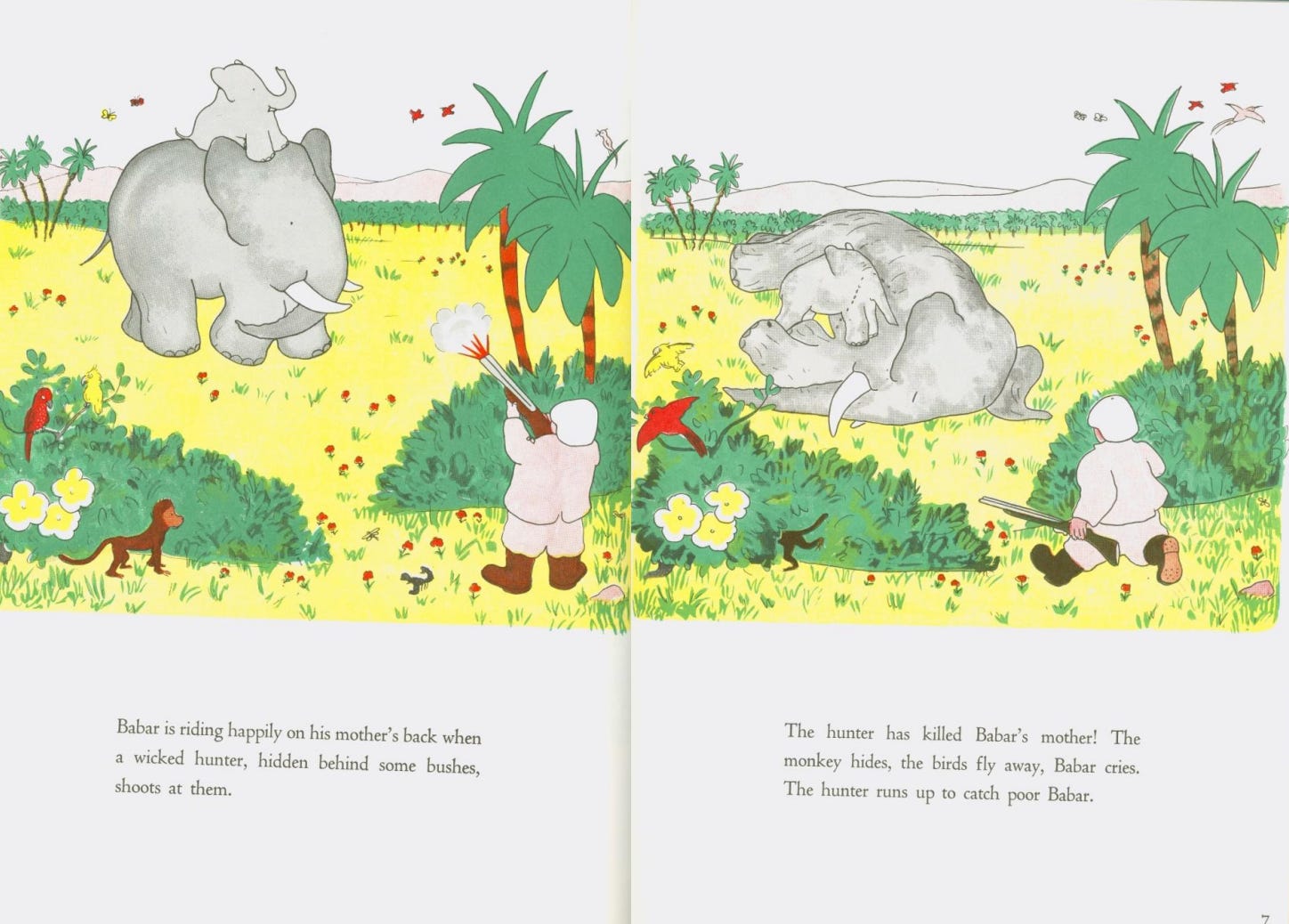
Babar’s happy youth is brief. He is born, he plays with a shell, and childhood is concluded. On the third page of the book, the elephant Babar experiences grief when his mother is shot from underneath him.
He runs away “for several days,” arriving at an unnamed city, and finally speaks. What does he have to say?
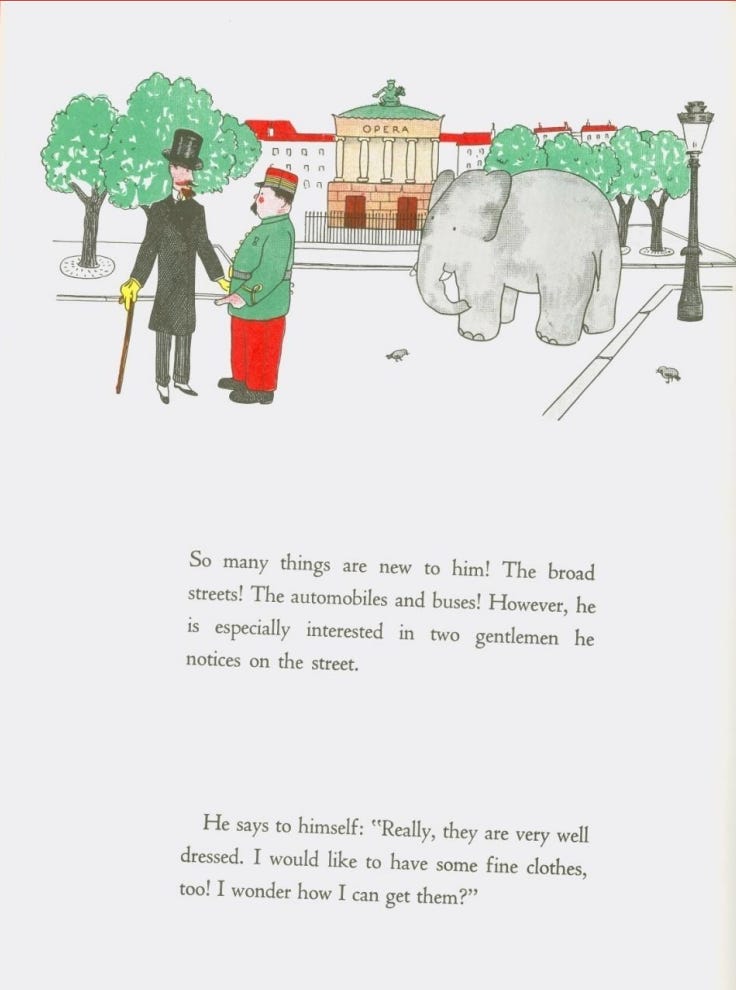
(Babar would have no way of knowing this, of course, being but recently arrived to human society, but he has not noticed two gentlemen on the street. He has noticed one gentlemen, who is addressing either a gendarme or a bus driver. But his instincts are quite correct; he patterns his own dress after the gentleman.)
