

Last week I spent some time at the GLBT Historical Society Archives with a group of residents from work, and I managed to sneak in a brief dose of research for Women’s Hotel III1 while I was at it, which is continuing apace.2
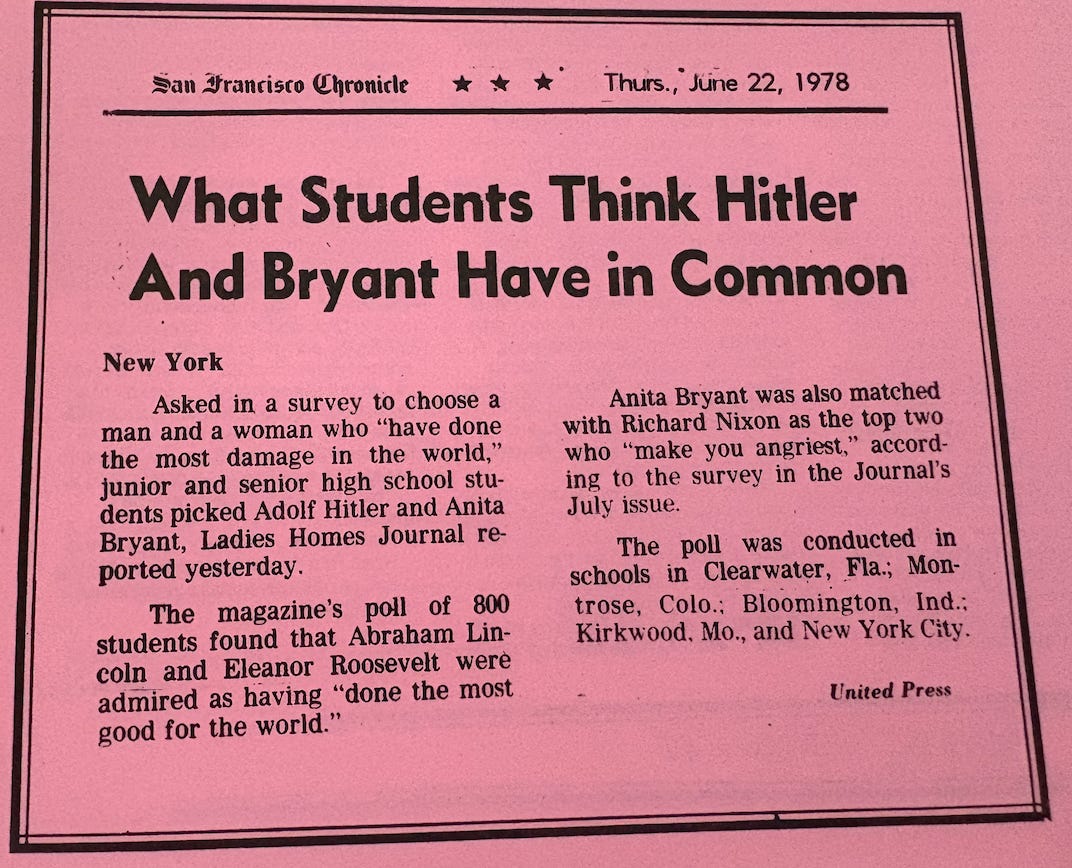
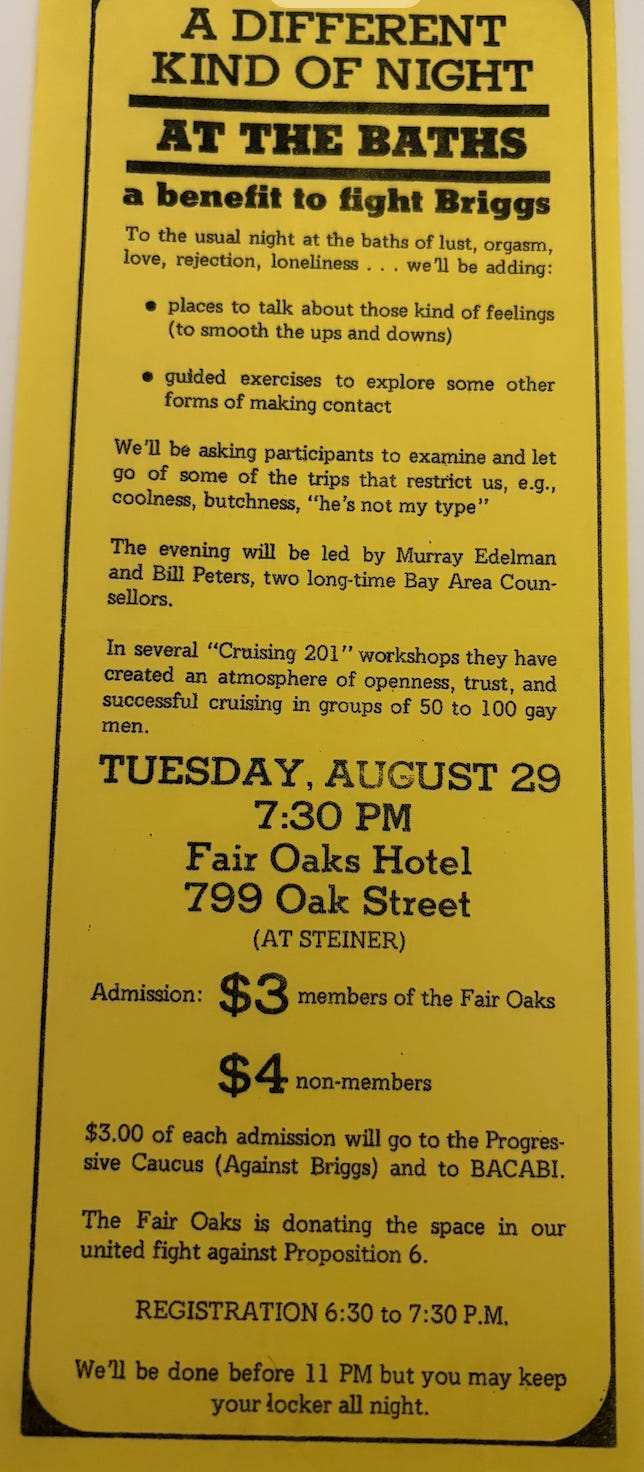
The materials the Society pulled for our group (“the Society” being old pal and Archive Director Isaac Fellman) were a few bundles of private letters, a photo album pasted into a wallpaper sample book, a collection of matchbooks, and ads countering the 1978 anti-gay Briggs Initiative.
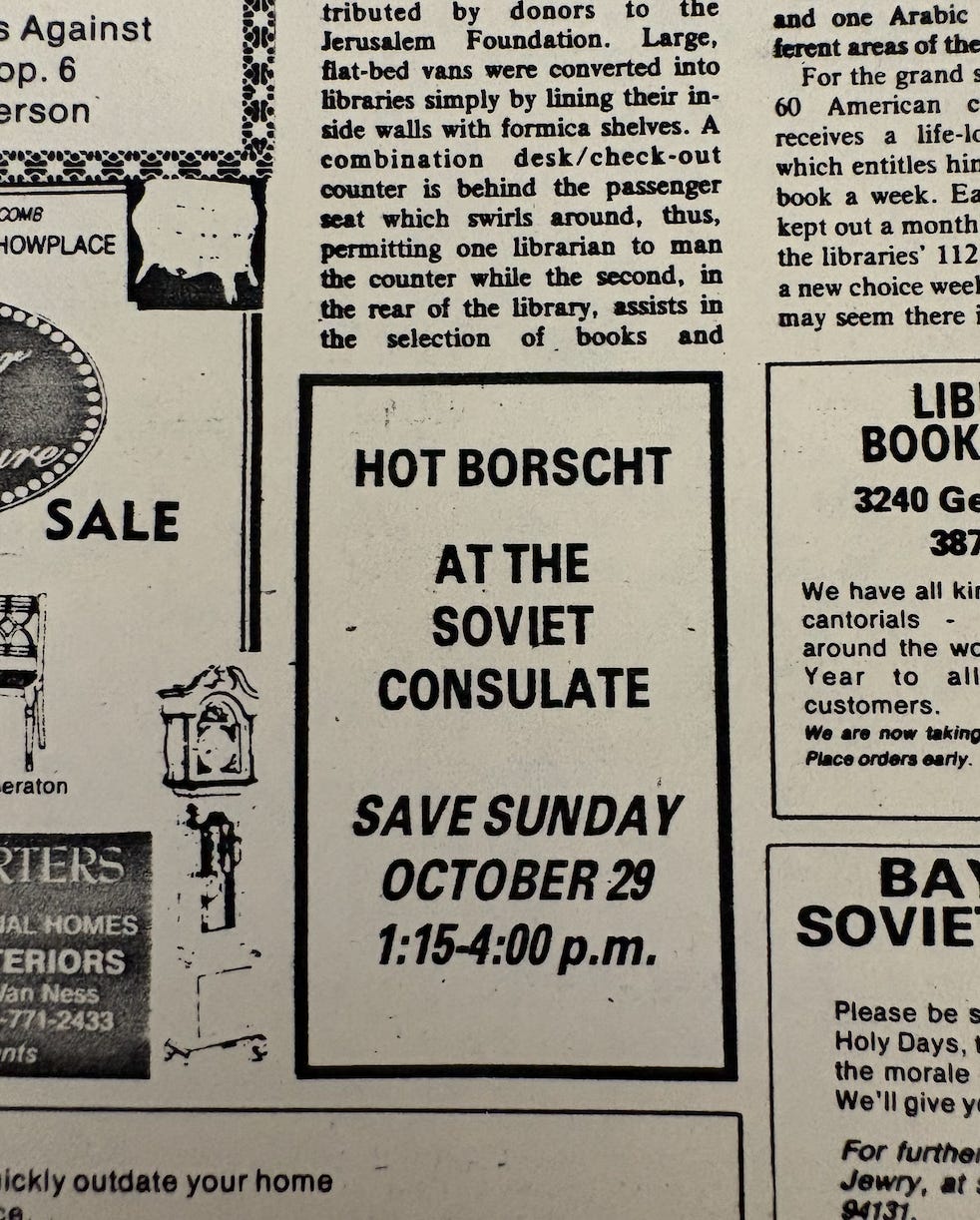
I was immediately distracted from the Briggs materials by an unrelated advertisement in the San Francisco Jewish Bulletin for hot borscht at the Soviet Consulate. It’s just a few weeks and forty years ago from now!
I was also, regrettably, enchanted by this caricature of State Senator Briggs and the accompanying quote about coming from “the bowels of the middle class.” Seeking to excavating those bowels has been the delightful task of my working life, and it has stayed with me as I revisit the world of the Biedermeier Hotel.

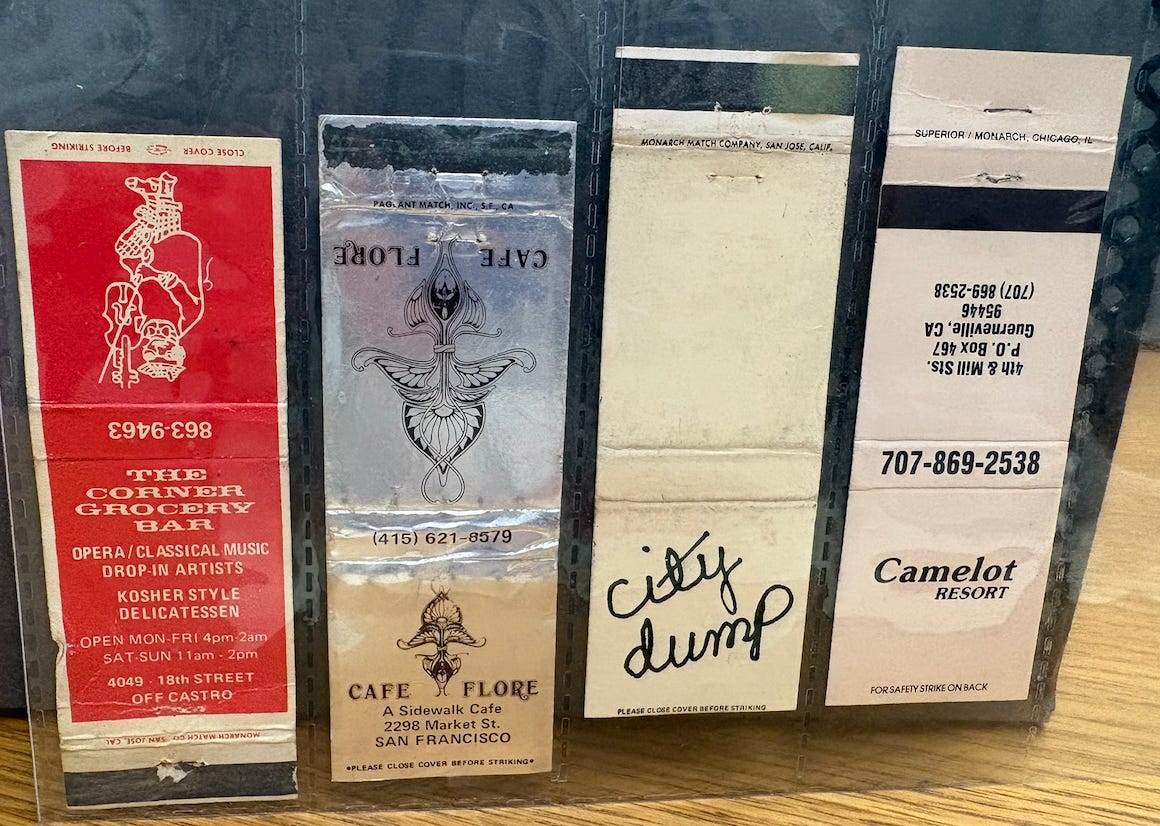
The matchbooks in particular interested me. What a life graphic designers must have had, once upon a time! What a world has been lost! “The Corner Grocery Bar” offers drop-in opera and kosher-style delicatessen?
“The City Dump” bar only existed during 1973, at 506 Castro Street; both before and afterwards it was known as Midnight Sun. For the last ten years it’s been vacant; most recently it was a Body Works shop.
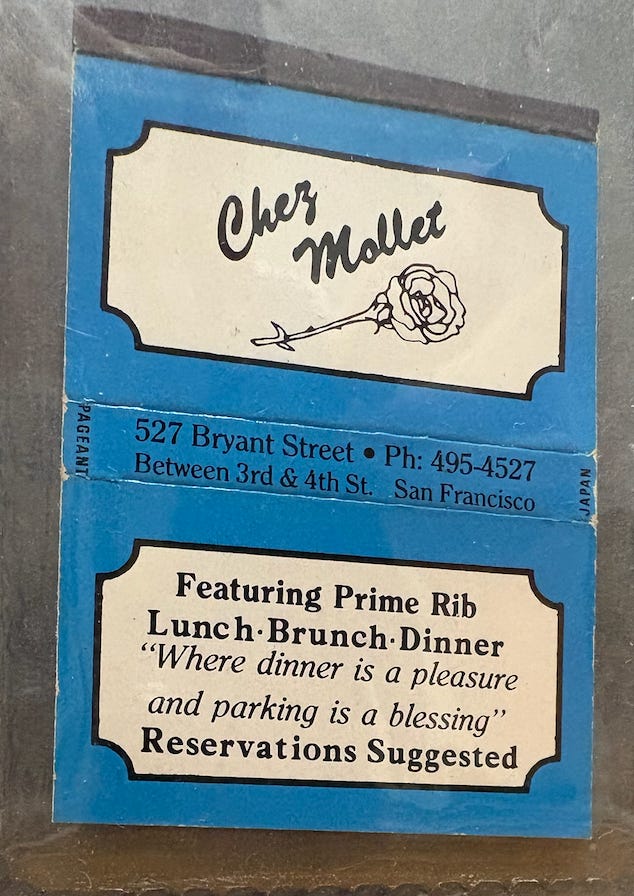
“Where dinner is a pleasure and parking is a blessing.” Some people go their whole lives without writing a sentence that good, you know.
Smoking, and fire, have certainly been on my mind as I work on WH3. There are a few little fires in the book so far, although I haven’t decided yet whether there will ever be a big one. I’m inclined to think not; the Biedermeier is not a place where big things happen.
It was less than two weeks after Mrs. Mossler had resigned her post as hotel director before the Biedermeier caught fire. There had been a little smoke and a great deal of excitement, and in the end proved disastrous for only one of the building’s inhabitants, which counted for something. The fire was not in itself unusual. In 1941 all residents had been issued Anholt safety ashtrays with the understanding that small domestic fires were an indulgence that ought to be curtailed during wartime, and that any former habits of using saucers, jewelry dishes, and empty coffee cans to stub out one’s cigarettes had better be broken at once.
This unfortunately did no good for Ramona Sylvaro in 703, who did not smoke but who did once, during a particularly alarming telephone call with her cousin Hazel about recent uncharacteristic behavior of their mutual cousin Arlen, set down her steam-iron on the seat of a parlor chair and promptly forgot about it, causing no loss of life or limb but forcing an evacuation on the seventh and eighth floors, after which she was roundly snubbed in a fit of patriotic unity. The chill did not lift until she enlisted in the SPARs as a chauffeur in the spring of 1942.
Ramona received six weeks’ of recruit training at Hunter College in the Bronx and a Mainbocher uniform, and considered herself to have gotten the better of the U.S. government for it. There would have been no question of Ramona’s being able to afford any garment of Mainbocher’s otherwise. Some of the girls who had led the snubbing – in particular Francine Gumbrell – lived to regret their decision. They had enlisted in the Women’s Army Auxiliary Corps, whose uniforms were made from the same materials as the men’s: olive-drab wool skirts, ankle-high Lil Abner field shoes, a khaki cotton summer-service suit, a horizon-tan wool crepe off-duty dress, and worse yet, an Army-issue girdle. The Navy did not trouble itself with the undergarments of its servicewomen, but provided them with made-to-measure navy suits in soft, heavy fabrics, the sort that stiffened the spine and brought a delightful fire to the eyes when worn. There was not a single Friday or Saturday between 1942 and V-E Day that did not see Ramona provided with an escort, but many a weekend evening saw Francine Gumbrell staying in to wash her hair.
Let go of some of the trips that restrict you! Coolness, butchness, “he’s not my type.”
We obviously can’t call it Women’s Hotel III, because that looks silly. I had suggested Women’s Hotel: Further Tales from the Biedermeier, but my editor pointed out, I think rightly, that this makes the book sound like a collection of short stories, which it isn’t. More Women’s Hotel doesn’t seem right, either. We’ll have to think of something, I suppose.
The manuscript is due in October, saints preserve us. Saints will preserve us, as it happens; I’m taking a few days off work this week and booking myself into the guesthouse of a local monastery to knock out a few chapters uninterrupted. Yesterday I got to start an email with “Thanks for the confirmation, Brother Ivan,” which I think bodes well.
Wom3n's Hot3l
Women’s hotel revisited