

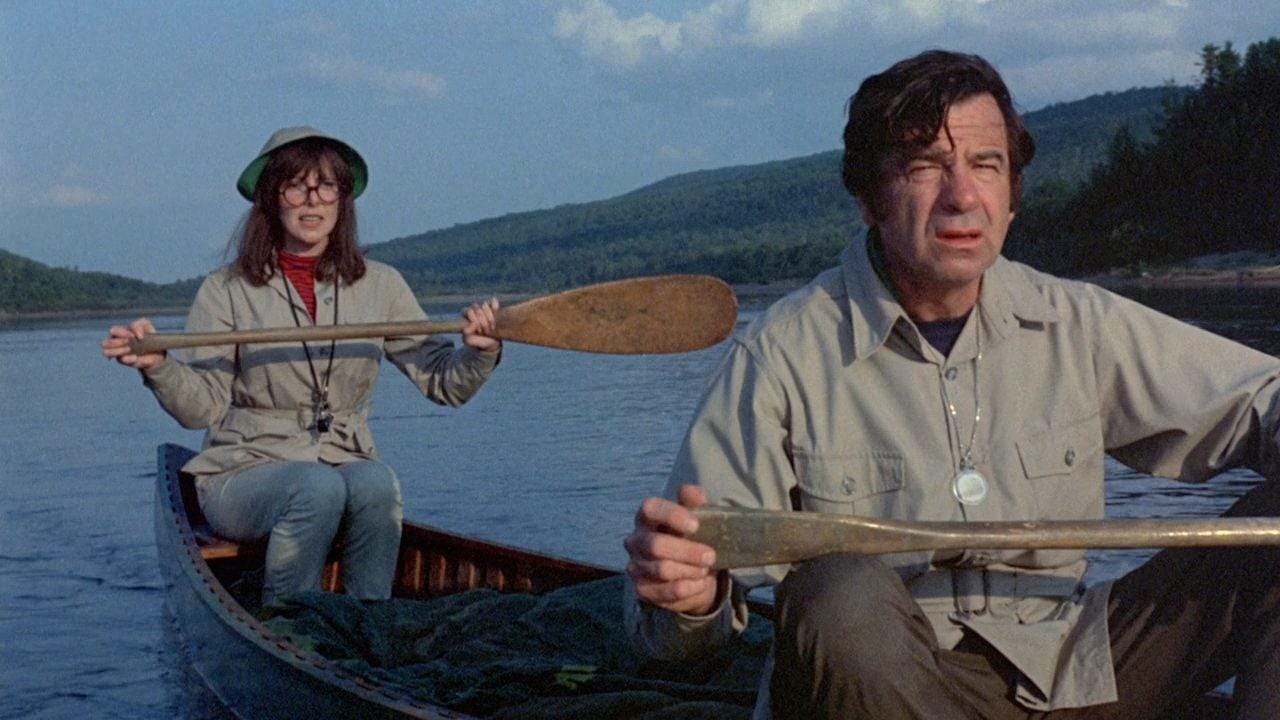
Back in 2024 an editor friend of mine asked me to review the Elaine May biography Miss May Does Not Exist. Unfortunately, I disliked the book so much after reading the first four chapters that I had to back out.1 I don’t mind the idea of writing a pan, but I don’t think I’m very well suited to it, and at a certain degree of intensity, I lose the ability to describe something that irritates me, and am reduced to pointing and trembling.
The upside is that it led me to revisit Elaine May’s first two movies, 1971’s A New Leaf and 1976’s Mikey and Nicky, which more than made up for the time wasted. A New Leaf is a Bluebeard comedy that asks the important question, “What if a vicious would-be wife killer developed the criminal equivalent of erectile dysfunction?” and you should see it at once if you haven’t already. May also co-starred in A New Leaf (which is quite faithfully based on Jack Ritchie’s short story “The Green Heart2) alongside Walter Matthau, who is splendidly, ideally miscast as the world’s oldest playboy.
He both looks and behaves like the Grinch in a screwball comedy about an aging roué named Henry Graham, who upon learning he has outspent his own trust fund, decides to marry and murder the first wealthy woman he finds bearable. He is so old, and so uniquely unsuited to impoverishment, and so attractively petulant that the only way I can think to describe him is if Jude Law’s version of Lord Alfred Douglas in the Stephen Fry Wilde movie suffered from Benjamin Button syndrome.3 I cannot recommend his performance highly enough.
Incidentally, Matthau’s hair is so improbably lush, robust, and twirling, especially when compared with his marvelously eroded, perpetually crestfallen face, I was absolutely convinced he was wearing a hairpiece (and not a very good one). He was 51 in this movie and looked every minute of it. But I was mistaken, and the hair was all his own. Apparently I had fallen prey to the same cruel lack of faith that plagued Pauline Kael:
A few minutes later producer Daniel Melnick and writer-director Buck Henry approach the actor.
“Am I in your next picture?” Mr. Matthau asks the pair.
Mr. Melnick jokes, “First you have to lose the beard.”
“No,” Mr. Matthau replies. “The beard makes me look less clownish, more heroic. Besides, I want Pauline Kael to see that my hair is real. She once accused me of having a bad toupee like John Wayne.”
Walter Matthau’s face in A New Leaf is like the picture of Dorian Gray: cunning, and old as sin, depraved and loveless and sinister, monstrous and melted, withered, wrinkled, and loathsome of visage. He looks like if a very old ventriloquist’s dummy were given the same wardrobe and chance at life as Pinocchio. But Walter Matthau’s hair in A New Leaf looks like Dorian Gray, the man: unfaded, insouciant, youthful, exquisite.
Henry Graham is told that he has no money. He reels onto the street, in an impeccably cut suit — who knew Matthau could wear clothes so well? Not I — while Ketélby’s “In a Monastery Garden” plans, whispering to himself in broken amazement: “I’m poor.” After taking a brief farewell tour of his favorite haunts (his club, the tailor, his other club) he staggers home to take counsel with his valet Harold4, the most devoted and disloyal manservant on the planet. (Perhaps rather than Dorian Gray, the apter comparison is to Hitchcock; A New Leaf is the movie you end up with if you were to drop Bertie Wooster and Jeeves into the plot of Rope.)
Harold first promises to give notice the day Henry runs out of money, and subsequently chides him against giving up:
HENRY: “What will I do?”
HARRY: “What any gentleman of similar breeding and temperament would do in your position, sir.”
HENRY: “Suicide?”
HARRY: “No, sir, I was not going to suggest suicide. I was going to suggest marriage.”
HENRY: “Marriage? You mean to a woman?”
HARRY: “Yes, sir. It’s the only way to acquire property without labor.”
HENRY: “Oh, I can’t, Harold. I couldn’t. I mean — she’d be there, asking where I’d been, talking to me. Talking. I wouldn’t be able to bear it.”
HARRY: “Well, it was only a suggestion, sir, but the alternatives are very limited and unspeakably depressing.”
It’s difficult to say whether Matthau plays Henry as a homosexual, as such. He is gay in the same way Rex Harrison’s Henry Higgins is gay, which is to say that it does not prevent him from developing a single-minded, murderous obsession with giving a perfect, permanent makeover to the one woman who matters to him more than anyone else besides himself.5
“The only difference between us is I am a man and you are a woman,” he tells Henrietta during a strained and uncomfortable proposal, “and we don’t have to let that interfere if we are reasonably careful.” She’s very pleased with him, strained and uncomfortable as he is; who better than a botanist to tolerate a sensitive plant?
It is more strictly correct to say the one girl who matters to him. It’s very important to the story of My Fair Lady that Eliza Doolittle is a girl, not a woman, and even though May was nearly 40 at time of filming, you cannot call Henrietta Lowell (later Henrietta Graham) anything but a girl. The only woman Henry considers courting (they go waterskiing together) is voluptuous, blonde, aware of her own sentimentality, and full of desire, and he flees from her in horror. But Henrietta is a girl, with a girl’s problems; she is awkward and self-conscious, shy and inexperienced, stuck in school (as a teacher rather than a student, but schoolgirlish nevertheless), cheated by her servants, bullied by her lawyer, and not yet alive to herself, and Henry finds her tolerable enough to want to murder. She is a botanist, she is soft-spoken, she startles easily, she never makes demands, only suggestions; she never contradicts Henry, only reroutes him, as gently and as inexorably as water.
Henrietta is such a nonentity, such a wife-shaped vacuum that Henry is forced to become a husband and eventually even a person to make up for her haplessness. At a certain point both he and Harold realize they have become a butler to his wife, and it is rather as if Henry Higgins and Colonel Pickering had both married Eliza Doolittle:
HENRY: “Oh, no. I forgot to check her before she went to school this morning. She’ll be walking around all day with price tags dangling from her sleeves.”
HAROLD: “I took the liberty, sir.”
HENRY: “Thank you, Harold. Was she free of crumbs?”
HAROLD: “Only a slight sprinkling, sir.”
Henry has enormous contempt for his wife, but nothing about her does not matter to him, which is why I think his repeated half-hearted attempts at uxoricide still come across as funny rather than depressing. Henrietta is never beneath her husband’s attention.6 It helps too that she never once realizes she is in any danger, and is never once hurt by anything he says. She’s like Pepe Le Pew in that way — shielded from all harm, bounding with unending vitality from crisis to crisis, never once breaking a sweat. From Henrietta’s perspective, she meets a very nice, slightly odd old man who marries her, improves her domestic life, helps her discover a new kind of fern on their honeymoon, and eventually agrees to come to work with her every day. Imagine a slapstick version of When A Stranger Calls, about a woman so hapless that she is safely inoculated against male violence — the “you don’t know you’re beautiful, and that’s what makes you beautiful” principle applied instead to vulnerability.
Moreover, his attempts to kill her are constantly being derailed by his indefatigable efforts at improving her life. Everyone else in her life is also trying to take advantage of her, and after they are married Henry cannot stand the idea of Henrietta’s life being any less gracious than his own. He fires, threatens, blackmails, and bullies them all out of her life until her home is filled with competent, respectful servants and beautiful floral arrangements.
Henry fails as utterly in transforming his wife as he does in murdering her. She becomes no more stylish, no tidier, no less accident-prone. In spite of his best attempts to improve her he manages only to make her happy. Two nonenties cannot coexist in proximity; one or both of them is going to have to become a person. Eventually he sinks so much energy into thwarting his wife that he finds she has become necessary to his happiness, and he is defeated at last. Splendid narcissist that he is, he cannot fail to fall in love with the blustering chivalric hero he has pretended to be in order to lull her into a false sense of security; loving himself in this new light, how can he bear to destroy the reflecting pool that shows his new face to him? You simply must see it at once.
[Image via]
The book opens in what I can only imagine the author believed to be a Maysian moment of daffy improbability, as she sits in a blonde wig on a bench outside of her subject’s apartment on a “stakeout.” The second chapter opens with “Imagine for a second that you’re twelve years old and a new transplant to Los Angeles.” Just write a book about Elaine May, please, and leave the wigs and hypotheticals out of it.
He couldn’t look older! I don’t know why I’m fixated on this, but he’s just so old. He’s the oldest baby I’ve ever seen in my life, and it’s wonderful.
Played splendidly by George Rose.
A New Leaf isn’t a Man vs. Man or Man vs. Nature picture, so much as it is a Murderous Queer vs. Conversion Therapy picture, and it’s a lot of fun to be in the position of rooting for conversion therapy to win, for once.
It’s the same appeal of the Liz-and-Jack relationship on 30 Rock. He’ll never stop criticizing your shoes, which means you have a powerful older man in your life who cares enormously about what your shoes look like, instead of tuning you out!
When my husband got his mfa at Columbia, his prof was friends with Elaine May and informed her that all the students were obsessed with her work.
Wanna come talk to them? he asked.
No, said Elaine May.
Great insights! Now do Mikey and Nicky!