

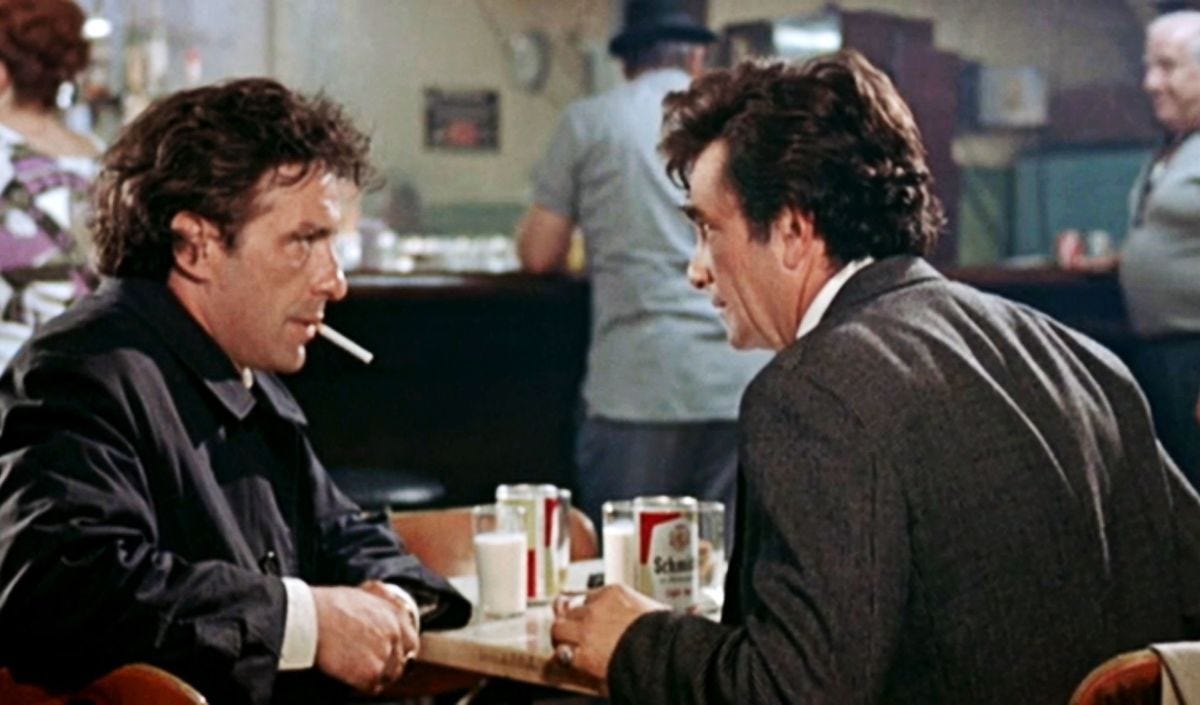
Elaine May’s Mikey and Nicky is coming back to theaters this summer, the one where Peter Falk and John Cassavetes play best friends who have been assigned to betray one another and try to delay the inevitable by running around Philadelphia all night drinking half-and-half and frightening women.
It’s very good and if you get the chance to see it in the theater I hope you do. It’s also a little stagey and more than a little exhausting in a way I find pretty realistic; every fight I’ve ever had with a friend or a lover has similarly felt totally pointless and insane. One leaves the world for a few hours, and nothing feels possible any longer. Why not switch coats and watches? Why not get off the bus and walk in the opposite direction? Why not go to the movies or get kicked out of a bar; nothing makes sense in the middle of an argument anyhow.


Recently I’ve grown a little talked out on the subject of women interpreting intimacy between men1 (see Return to Pervert Ethnography Island if you’re still looking for more), but I have to admit that Elaine May is the indisputed queen of such interpretation. Not five minutes into her second movie, Mikey and Nicky, Peter Falk breaks down a door so he can start gentling John Cassavetes like a damn horse, petting his flanks and rubbing pills down his throat.
The script opens with a little explanation of the setup that never makes it onto the screen:
One of the oddest and perhaps, most frightening characteristics of a “hit” is the behavior of the victim who is aware that he is slated to die.
He knows, almost as a certainty, that someone inside his organization, someone whom he considers a friend, will be used to set him up for the kill. This is done for obvious reasons. It is easier to kill a man who has been set up, and he can only be set up by a friend, because who else will he trust? The friend must also be known and accepted by the organization, because who else can they trust?
There is also a flavor of ritual about the procedure, as primitive as the Cosa Nostra’s ritual kiss of death. Perhaps it is because of the ritualistic .response of the intended victim. Knowing the custom of the set-up as well as he does, and sometimes having actively participated in it, he will, almost invariably, call on someone inside the organization for help. Why he does this is a matter for speculation. That he does do it is a matter of fact. That he seldom escapes is a matter of record.
Some Thoughts on Elaine May's "A New Leaf"

Back in 2024 an editor friend of mine asked me to review the Elaine May biography Miss May Does Not Exist. Unfortunately, I disliked the book so much after reading the first four chapters that I had to back out. I don’t mind the idea of writing a pan, but I don’t think I’m very well suited to it, and at a certain degree of intensity, I lose the ability …
I don’t know how many times Falk intimidates Cassavetes into taking a pill in this movie. At least three. And that’s to say nothing of the crackers he force-feeds him. When people talk about Mikey and Nicky they often focus on how May shot an absolute unreal amount of footage for it, something like a million hours more than Gone With The Wind, like she just unhinged her eyes and turned into this endlessly hungry camera and never stopped looking at these two guys for the rest of their lives.
Vincent Canby thought the movie was a mildly interesting failure —
“It’s a melodrama about male friendship told in such insistently claustrophobic detail that to watch it is to risk an artificially induced anxiety attack. It’s nearly two hours of being locked in a telephone booth with a couple of method actors who won’t stop talking, though they have nothing of interest to say, and who won’t stop jiggling around, though they plainly aren’t going anywhere. They just seem to be carrying on—making elaborate actor fusses—in front of the camera. Miss May is a witty, gifted, very intelligent director. It took guts for her to attempt a film like this, but she failed.”
— although I think if you look at the review it’s clear he’s anxious that she’s somehow contaminated Cassavetes and Falk with her womanly interest (“Melodrama, claustrophobic, artificial, jiggling, carrying on, fusses,” are these men behaving like men? are these men behaving like women? are these friends behaving like friends?). Canby’s not precisely wrong about the fussing, of course, but I think John Cassavetes and Peter Falk are about as good as actor-fussing as anybody. Sometimes two hours of watching guys with unbelievable heads of hair doing a lot of jittery prop work is just the ticket.
Oddly, Canby also seems to think that Mikey and Nicky grew up in California (“It’s about a couple of small-time Los Angeles hoods who’ve grown up together, joined the same mob and now, on this particular night, find their lifelong relationship passing in front of our eyes in aggressive close-up”), even though the movie is set in Philadelphia. In fact Mikey and Nicky is arguably about how it is impossible to ever leave Philadelphia once you are in it, even if you want to, very badly.
I tried to take notes the last time I rewatched Mikey and Nicky, because I was interested in the reactions it produced in me, but they all looked more or less like this:
“All my life I wanted to be a guy who knew a guy for thirty years”
“I want to shave a man’s face. No funny business, just a solid job”
“People always used to get ulcers, but you never hear people talk about ulcers anymore. They’ll still be anxious or stressed, but they won’t get ulcers anymore”
John Cassavetes behaves unbearably throughout; he is desperately attached to his wretched little life, and becomes more desperate and wicked and brattish the closer he gets to losing it. His behavior is objectionable — more than objectionable — but really the reason no one can stand to be around him is they all know he’s perfectly aware that he’s going to be killed.
If A New Leaf is about the joy of realizing you no longer want to kill your wife, Mike and Nicky is about the devastation that comes from realizing you’re going to let Ned Beatty — a man with a friendless face, a friendless voice, a friendless carriage, a friendless spirit — kill the guy you grew up with.
I’m inclined to think that Henrietta in A New Life is aware her husband is planning to kill her; I’m also inclined to think she manages to get out of it by offering to sign all her money over to him before they get married, less because she thinks of the cash as a straightforward exchange and more because she wants to use his own weight and momentum against him. Henry wants Henrietta to become civilized, or at least civilizable, and Henrietta wants Henry to experience the pleasures of helplessness, and they both more or less get their way in the end. Nicky is similarly aware, but the difference is that Mikey is going to let him die; he doesn’t really want to do anything to him anymore, and there’s no way to get out of that sort of thing.
“I just want to not do it anymore,” Falk tells him on the street in the middle of one of their endless quarrels. “Be your friend.”
“Then I’ll be your friend,” Cassavetes counters, like that fixes everything. Every once in a while in life you’ll run into the kind of person who refuses to be broken up with, and they’ll give you some of the longest nights of your life.
Which is not to say I’m over the subject personally! I think women and men ought to interpret one another all the time.
People don’t get ulcers anymore because they cured ulcers! They won a Nobel for it, it’s such a cool story. I think you might enjoy the style of this article about it:
https://www.thelancet.com/journals/lancet/article/PIIS0140-6736(05)67587-3/fulltext
This movie reminds me of some of the worst nights of my life with an accuracy unlike any other movie I've seen. It made me so anxious that I do not think I could watch it a second time. 10/10, great film, highly recommended
A friend of mine once summarized Mikey and Nicky as "Elaine May catches you watching Goodfellas and forces you to smoke the whole pack," and I think about that a lot!