

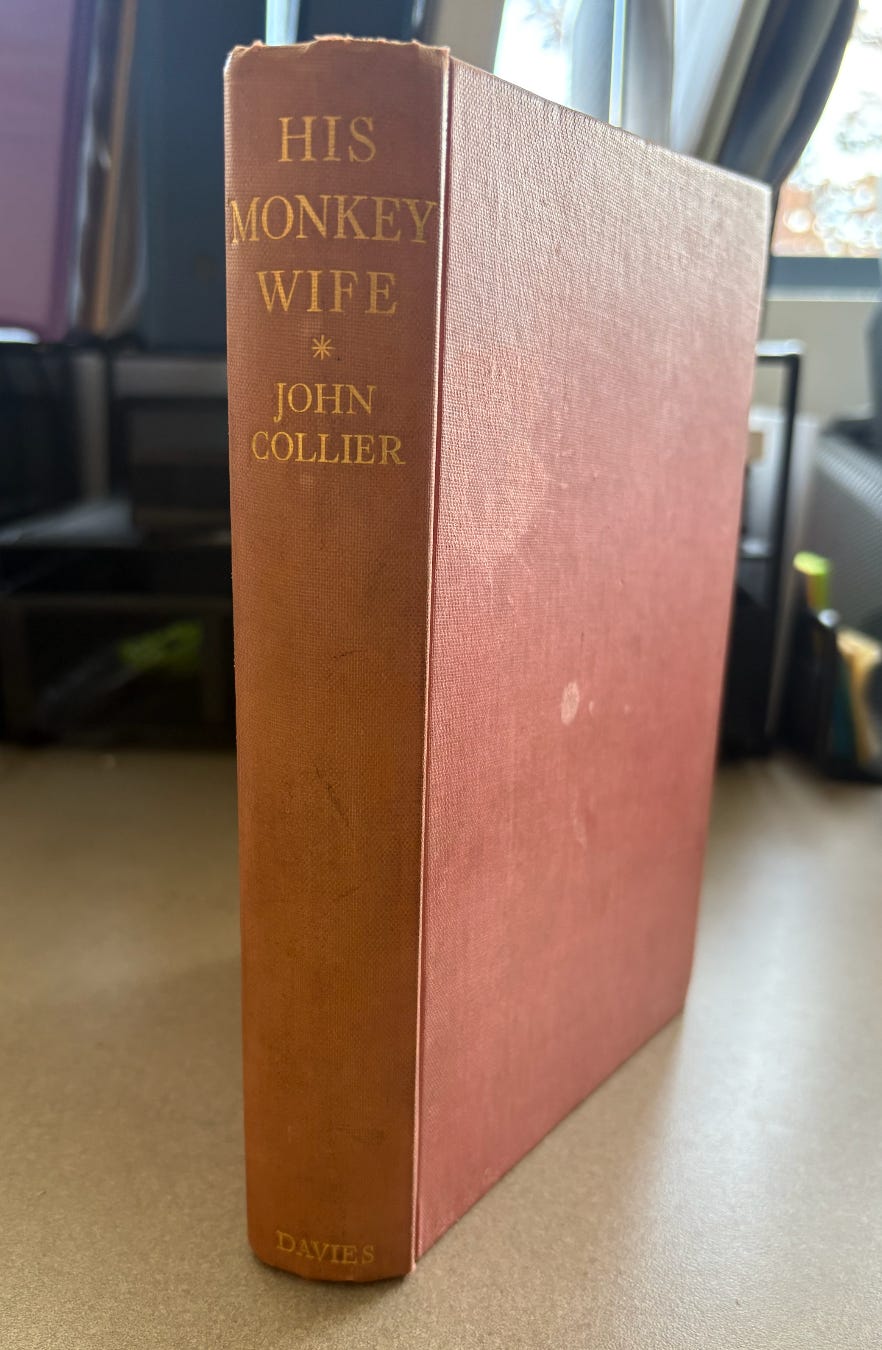
You don’t need to go out and get a copy of His Monkey Wife, I don’t think. When it’s good, it’s very, very good, but just as often it drags. I don’t know whether the fact that Anthony Burgess loved His Monkey Wife carries much weight with you. It did not with me.
But when I read aloud the line “The chimp, drowned in happiness, heard his words falling like the sound of bells from an infinite height” I laughed so hard I wept in the car,1 and I believe you ought to benefit from my experience. And when I arrived at “Who would have thought, seeing all this, that beneath that rather Charlotte Brontë exterior, there was actually a Charlotte Brontë interior, full of meek pride, hopeless hope, and timid determination?” I gnashed my teeth with helpless fury over not having come up with the line myself.
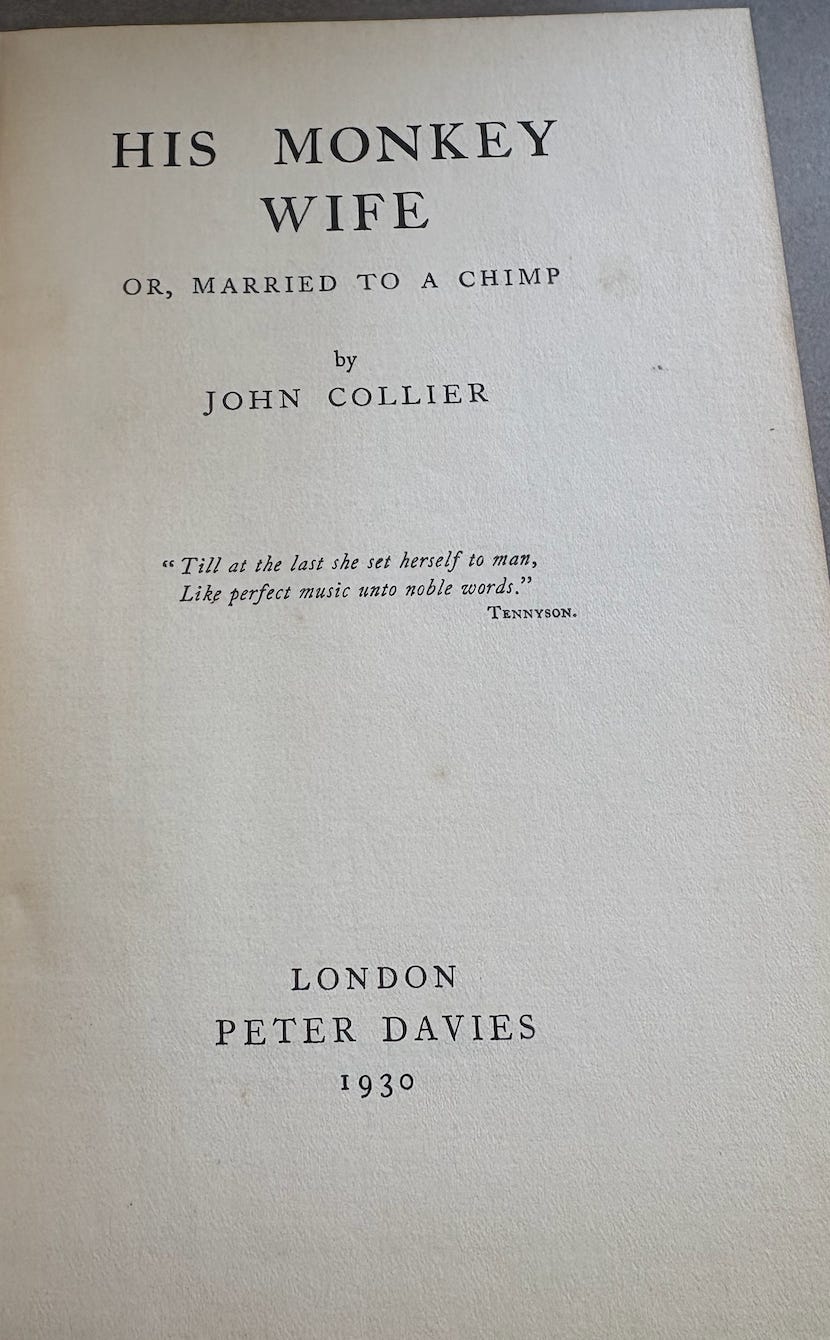
I have selected the best bits from John Collier’s 1930 novel His Monkey Wife, wherein a man accidentally marries a chimpanzee2 named Emily. Naturally this drives a wedge between himself and his fiancée Amy, but Emily’s quiet dignity and loving heart eventually carry the day.
“Can you wonder that, petite, dark and vivacious, she is the life and soul of the lonely bungalow, so that the passing trader or Colonial Office man has no sooner thrust out his legs into the cool comfort of his evening’s rest, than he says, “Now then, old man, where’s that chimp of yours? Let’s see Emily. Ho! Ho! Ho!”
But as she ambles forward on such occasions, turning a somersault, perhaps, as slowly and gravely as day and night, see! her smile dawning at the end of it has something of trouble and strain splintering under its sensitive flexibility. Loyal in her support of Mr. Fatigay, quixotically hospitable in her determination to give such guests what they are most fitted to enjoy, she is nonetheless ill at ease. Yet she masks it.”
“She saw pictures enough of cats with the letters CAT printed beside them. Is it so hard to understand how she came by a curiosity as to the nature of letters, and even, perhaps, of the abstracter function of literature?”
“Who would have thought, seeing the trim little brown figure trip so self-containedly through the village, or describe such a suave arc on the end of the swinging bough that landed her pat, here, back again at Mr. Fatigay’s feet, as he sat at dinner on the veranda; who would have thought, seeing all this, that beneath that rather Charlotte Brontë exterior, there was actually a Charlotte Brontë interior, full of meek pride, hopeless hope, and timid determination.”
“This, as when the spring grass cracks stone slabs of pavement, was a signal instance of the futility of the strongest antivital contrivances, when pitted against the forces latent in even the very softest of living tissue. Mr. Bernard Shaw would have been delighted. So was the chimp.”
“Frowning slightly, she peered hard at the crabbed writing. Frowning still more, she peered still harder. At last the fatal words conveyed their message to her.
“My beloved darling Amy.”
It was the draft of a love letter. Aghast, the stricken chimp reeled back, one hand pressed to her brow. Her dream world lay in ruins about her feet, and, with the deathly faintness which now spread over her, it slowly began to revolve around, evoking a sensation not unlike (yet how unlike!) that procurable on the joy wheel at the fun fairs and luna parks of the carnal capitals of Europe…
She longed to feel again, to know, the very wound against which she had clenched her mind; it was, even in the very killing of her, life, and, compared with it, all that she could fly to was desert and dead beyond bearing.
Besides (and here she took wider leaps) there might be some unimaginable misunderstanding. Perhaps he was writing a novel.”
“Let the future bring what it may,” she thought, standing very erect and earnest in the middle of her little white room, “my place is beside Mr. Fatigay, and who knows but that even he may come to be grateful to the humble chimp, when the dawning sense of her love and constancy shines as the only light on the dark path he seems fated to tread.”
And, going down to his study, she took from the shelf a pocket encyclopedia, and soon was deeply immersed in an account of the divorce laws of England, which she read, not from vain hopes of its future practical utility, but for its prose, which struck her, in its stark and puritanical terseness, as being far superior to the more exotic phrasing of the marriage service.”
“With this, she drew into her shell a little, and, as there was little entertainment in the sight of even a chimp sitting hour after hour staring at a book, the fickle interest of the voyagers soon slackened and was diverted. A seaman was discovered to be a woman masquerading in man’s clothes. An actress’s pearls were declared missing. A fancy-dress ball was organized, and in the general excitement the chimp soon ceased to be an object of remark.”
“For the heart is, in a sense, like the Prince of Wales; we would not have it cut in stone, yet how pathetic it is, when, as at Wembley, we see it modeled in butter.”
“Good heavens!” said Amy at last. “Is that the wonderful present you’ve been hinting at in all your letters? A monkey! Darling! My poor old boy! What in the world could you have been thinking of? What should I want with a monkey? Covered with fleas, no doubt, and sure to make a filthy mess about the house! You’d better shoot it, or give it to the zoo or something. I don’t want it.”
“Her name’s Emily,” said Mr. Fatigay, very cast down.
“Well, I like her,” said a simple fellow, “because she’s a little woman. A bouncing little woman. I like them like that. My first wife was a bouncing little woman. My second wife was not. I was deliriously happy with my first wife. With my second — not altogether so. I like a bouncing little woman.”
“I must get a cat. It would be terrible if she found out that I had no cat. But if I had a cat, and she is a cat lover, she must become quite interested. She will very probably express a fondness for the animals. At once I will reply, ‘But I have another cat, a little one. Some consider it beautiful. May I, dare I . . . beg your acceptance . . .’ ”
And, lost in the sweet reverie, he smirked and bowed upon the empty air.”
“Emily next thought of appealing to Amy by the only means in her power, pantomime and passages from the printed works of great minds.”
“Emily,” she said, speaking very slowly and distinctly, “I have a little surprise for you. It struck me that it might be amusing — and Mr. Fatigay, needless to say, has raised no objection — if you were to perform the part of bridesmaid this morning. Freak weddings are quite the thing in these days, and ‘The Monkey Bridesmaid’ will be very attractive to the gossip writers, if to no one else.
“Open that box,” she continued, pointing an imperious finger. “There are two white dresses in it. Bring them here. “This,” she said, “is yours, and you may get into it, and lay the other out for me, while I take my bath. Unpack the hats also, which are in that box above the wardrobe. It’s a pity Mother’s ill, and can’t come, but she’ll love the photographs.”
And, drawing a batik silk dressing gown about her shoulders, she went to the bathroom, leaving the poor chimp to savor the full bitterness of the cup now placed before her.”
“Oh!” said he. “It is only Emily, fallen over a chair.”
For Amy was already beginning to stir a little in the throes of a painful returning consciousness. The ardent bridegroom, instead of rushing up to set his fallen pet, as he imagined, upon her feet, turned again towards his bride, and, lifting her veil with a gentle hand, he bent down to imprint a passionate kiss upon her lips.
The chimp, in the tumult of whose consciousness all but her invulnerable love was lost, protruded these responsively.
A pause, an abyss in time, followed. Then the astounded man, turning to where the clergyman was departing the church, cried out in the voice of agony: “Hi, sir! Hi, sir! You’ve married me to a chimp!”
The clergyman, suave, debonair, equal to any emergency his ragtag and bobtail parish could thrust upon him, conscious too, that standing in the carven doorway, haloed in his blondness against the murky air without, he must look rather like the St. George in his stained-glass window, especially with the bowed and writhing form of the verger cringing at his knee, replied in befitting tones: “Well, sir, what of that? The Church, you should be aware, is inspired from on High, and is therefore always abreast with the latest discoveries of science.”"
“But what shall we do now? Surely, in spite of what the clergyman said, this marriage can’t be legal. There’s a law against chimps.”
“Mr. Fatigay peeped humbly out from behind the sumptuous car to feast his eyes with a glimpse of this happy being. The door swung, a commissionaire bowed respectfully, and our hero’s eyes protruded from their hollow sockets. For there, smartly groomed and fastidiously fastening a glove, stood Emily, his monkey wife.”
“In spite of her tumultuous feelings, the chimp remained mistress of herself and the situation.”
“At once the docile chimp hurried to the typewriter, whence a few minutes later she drew a sheet on which was written: “This place, my dear master, is a desirable first-floor flat in South Audley Street, W.1, and until you entered it I have considered it mine, but upon that auspicious day it automatically became yours, with all else that belongs to me, including, needless to say, such trifles as my body and soul.”
“Thank you, Emily, very much indeed,” said Mr. Fatigay.”
“Emily!” he cried. “How could you? Ah, the libertine! Did you? You couldn’t! You didn’t? Yes or no?”
“When he thought of what she must have suffered, and when he contrasted her constant good humor and control with Amy’s pampered peevishness, he began to feel for her not as a chimp, but as a woman, or, at the very least, as an angel.”
“Yes, I see you’ve got Emily,” replied Amy brightly. “And what a nice place you’ve got, Alfred. You must have prospered. But why do you dress the monkey up in that gaudy thing? Surely it’s unsuitable for a servant? It would be for anyone, for that matter.” For she meant to show how utterly impossible it was for any normal civilized person to conceive that the chimp could exist on any other footing.
“Emily isn’t a servant,” said Mr. Fatigay firmly. “If either was the servant here, it would be me. This place is hers, for she’s now a well-known dancer, and she simply saved my life by taking me in when I was starving.”
“You know perfectly well,” said Mr. Fatigay, “that none of your insinuations about Emily and myself are true — put that teapot down, Emily — either in the past or now. Whatever it was you felt when you came here, you’ve not gone the right way to bring it off. And vague accusations will carry us no farther. Why don’t you say it downright?”
“Well, if you force me to, I will,” said Amy. “You don’t know just one thing that may alter your opinion of your beloved wife. You don’t know that it was she who threatened me with a carving knife, and made me put on the bridesmaid’s hat, and would have killed me if I’d said a word — it was she who spoiled everything I’d been longing for — and on my bridal day, too.”
“Good god!” cried Mr. Fatigay. “Emily! Emily, is this true?”
The chimp nodded piteously.”
“Mr. Fatigay looked at the chimp more in sorrow than in anger, for even in his shaken state he found the motive thus indicated to be at least a possibly forgivable one.”
“No, Emily,” he went on, “remain where you are. I will show Amy to the door.”
“Well,” said Amy with a dry sob of humiliation, “if you treat me like this, don’t be surprised at anything you hear about me and Dennis, that’s all. Or anyone else for that matter. You’ll have driven me to it by your hardness.” And she began to weep.
“Don’t cry, Amy,” said Alfred. “The people in the street will see you.” And he closed the door.
“Emily!” he cried, as he turned back to where the chimp stood, waiting with downcast doubtful gaze. “Emily! My twice preserver! My good angel! My consolation! My wife.” The chimp, drowned in happiness, heard his words falling like the sound of bells from an infinite height.
Several cameras clicked; it had been impossible to conceal the monkey dancer’s romance from the press.
“My message to your readers,” said Mr. Fatigay, when he had escorted his shy bride to her stateroom, and was able to give his attention to the group of slick young interviewers who surrounded him, “is simply this. It is true my wife is not a woman. She is, in fact, an angel in more or less human form. My experience has taught me that they are unequaled as soul mates, if that is the correct term, when skies are either gray or blue. Behind every great man there may indeed be a woman, and beneath every performing flea a hot plate, but beside the only happy man I know of — there is a chimp.”
Well, there you have it. It certainly delivers on the promise of the title.
I was reading in the car, as is my custom, during a lunch break at work, on account of sometimes I have to take my lunch break out on the road on driving days because the state of California says I have to take my lunch break before my fifth hour of work or else my employer has to pay me overtime, and my employer doesn’t care to pay me overtime.
Which I know is not a monkey
“His Monkey Wife, or: Married to a Chimp” man Collier REALLY wants to make sure you don’t miss the book’s premise
i have no idea what "beneath every performing flea a hot plate" means but i assume it's true