

Danny: Hello my dear wife,
Recently we saw the movie Backrooms together. I think we both had quite a good time, although I hadn’t expected the primary onscreen relationship to be between a man and his therapist.
Did you get the sense that her self-help book was meant to be sort of gimmicky/inauthentic? Normally when I see an infomercial for a self-help book in a movie, it’s pretty clear that the movie wants me to think of it as a money grab, but I’m not quite sure about this one. I remember a big part of season one of Severance is Adam Scott’s brother-in-law’s self-help book, which I remember finding very (if broadly) funny, but Dr. Mary’s claims seem a lot more restrained, and her delivery in the voiceover reads more melancholic than authoritative.
What did you think of their final session, where she told him off? “Tie me up, blame your brain; you are your brain, you dipshit.”
Grace: I really liked this movie too. I’ve seen a number of the more reputable US film critics seeming a little lukewarm on it, and preferring OBSESSION, which, while interesting, is much less so to me than BACKROOMS. But then they all seem to misunderstand OBSESSION too.
Justin Chang’s comparison in The New Yorker this weekend completely fumbles the plot of OBSESSION, which concerns a regular Gen Z nice guy named Bear wishing that his crush Nikki would fall in love with him, and the wish coming true. Then, Chang writes “despite [Bear’s] superficial nice-guy pose, is all too happy to reap the benefits.“ Nothing could be further from the truth! In fact, the moment Nikki reveals herself as a lover, rather than merely a beloved, Bear’s fragile masculinity recoils and never recovers. Desire for oneself, Nikki insists when describing a fiction she’s writing (before her brainwashing), is unattractive in others, and the truth of that sentiment is exposed as Nikki becomes a screeching void of terrorizing love. Chang further thinks that the out-of-control ambivalence Nikki exhibits, careering between abject affirmation and murderous rage, is “the spectacular by-product of a losing battle with not only the unseen entity that has seized control of her but also with the man who made it happen.” Late in the film, we do learn that a non-brainwashed Nikki still exists somewhere, and can speak when her hijacked body is sleeping. But still, there is nothing to make the viewer think that Nikki’s swings of violent lust and violent hate are the result of two entities struggling for control of a body: surely, those swings themselves are instances of the singular object named in the movie’s title.
I mention Chang’s OBSESSION snafu (and he is generally an excellent critic) because part of the challenge of these two movies is that they are both made by very young men, who are younger than the majority of their audience: OBSESSION’s Curry Barker is 26, and BACKROOMS’ Kane Parsons is 20. That spectacular fact conditions the way that you or I, or Chang, encounter these movies: they are generational testimony from people we don’t understand (the Skibidi covid cohort), and perhaps also occasions for a normative pedagogical impulse that one doesn’t usually get in response to horror cinema.
So a question like “what did you think of their final session” becomes also a question like “what is the future of psychoanalysis?” or “has therapy been displaced by optimization?” I like all these questions, but they all sort of wrong-foot me in different ways.
The first question is, under what circumstances could we consider that scene over the dinner table to be a session? Clearly, Clark is staging it that way, and invites Mary to walk back through the transcript of their earlier section, with each utterance of hers (in his mind) peeling the words off his record and tossing them into the no-place of the Backrooms. It is hard to avoid evoking Marc Augé when discussing this movie, but I find his actual work oddly static and unmoving.1
Yet in so far as Clark’s set up seems to intensify the logic of the verbal role-play in session, its inadequacy as a diorama is all the clearer. Mary has never seen Clark’s house, but the audience has seen hers, both her current home and the mythically-resonant home of her childhood, in which she was trapped by her mother, an agoraphobic psychotic.
Clark’s homelessness, on the other hand, is axiomatic. He has been kicked out of the house he owns—a wanderer, like Odysseus, as well as a seafaring pirate and a gallant sultan. So whose home, exactly, has he recreated in the Backrooms? Perhaps that from which he has been cast: when he mutilates the woman-furniture-object-sculpture, she is positioned in the kitchen—almost cowering—like a frightened, belittled wife; that is, the violence against her scalp mimics somehow the violence Clark had committed against his ex. Perhaps, at this point, we learn that he murdered or attacked her before leaving. But if it is his home, Mary doesn’t know it: to her, and to us, it looks like her childhood, all blockage and wreckage, half-light and threats of madness. (I was reminded of Oz Perkins’ interiors in LONGLEGS, here and elsewhere.)
So then Mary, undergoing a regressive intervention completely unknowable to Clark, loses her own shit and experiences her own role-play breakthrough: unable to do so as a child, now finally she can tell the crazy person she has spent a lifetime trying to cure that he is the problem, and she can’t help him, and he should fuck off and die, which he promptly does. Mary misdiagnoses Clark as her own mother, ascribing to him a passive-paranoid position that might vaguely ring true, but rather lets him off the hook for his physical violence and more perfectly fits the passive agoraphobia of the mad mom. It’s quite an ingenious psychoanalytic subversion: the analyst’s countertransferential breakthrough succeeds through the literal and figurative sacrifice of the patient.
Parsons’ investment in psychoanalysis is, I’m sure, close to zero; but the question of whether language has a role in liberating us from the “loops” that protect and terrorize us, is a central concern of his film. His answer would seem to be something like: plenty of hope, just not for us.
Danny: I can’t imagine she was able to bill him for it, so in that sense it probably wasn’t a session. I shared your sense that Clark’s scalping of the furniture-woman was an admission that he had probably attacked the wife he claims kicked him out, and possibly killed her.
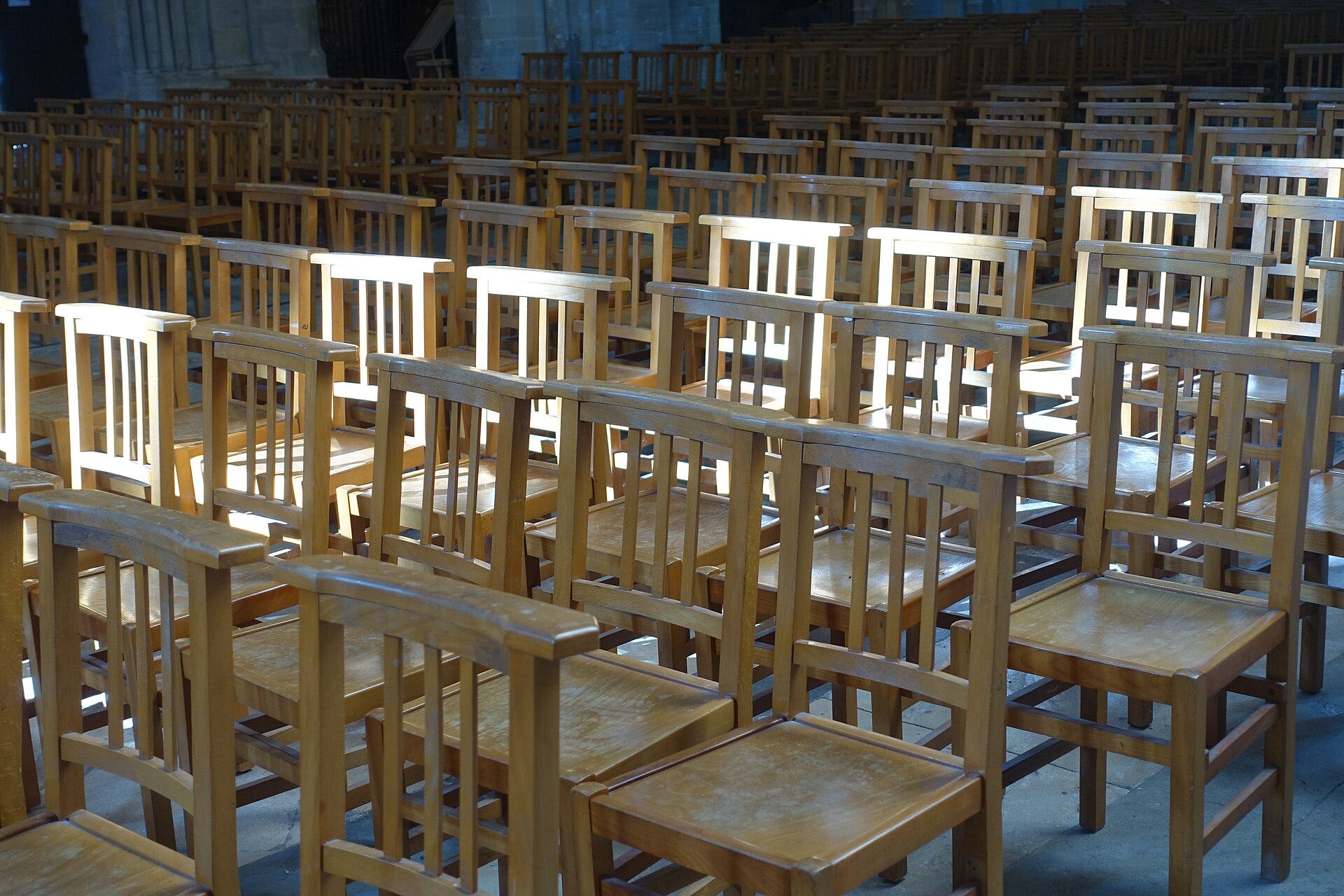
I enjoyed how deliberately slow and repetitive the movie was before this scene, and how piratical and unpleasant the movie was afterwards. Also like Longlegs, Backrooms is interested in mostly-wordless flashbacks to growing up with a hoarder mother who plasters the windows with newspaper. Mentally ill cinematic mothers are often depicted as hoarders, certainly more often than mentally ill cinematic fathers are. Crazy mothers are accretive, they accumulate instead of distribute; I didn’t pack your lunch today but there are a hundred boxes blocking the front door, will that do? That’s probably related to how much the central conceit of the movie seemed to be Aren’t chairs frightening? And I found the question persuasive! I kind of do think they are, now.
Sooner or later, everything and everybody becomes furniture. And what good does language do for a chair?
Grace: I’m also persuaded that chairs are frightening! Or rather, the tendency of objects to become chairs, which is to say, to become inert, receptive, and movable. The revelation that the creatures are stuffed with plastic fluff, but wet and apparently edible, is appropriately grotesque, because it reveals the indifference of the remembering-machine to flesh. That which is remembered is thereby manufactured, a process which is crueler than death: remember, man, that thou are wet plastic fluff, and to wet plastic fluff thou shalt return.
At the end of the film, when we see Mary smoothed out into a plastic form, the Backrooms scale back to become the setting for “Ozymandias”: “round the decay / of that colossal wreck / the lone and level sands stretch far away.” This rescaling is accomplished technically by a montage of stills, depicting the space’s gradual hollowing out. But while this moment was doubtless handled skillfully, in a sense it pulled back the most disturbing element of the Backrooms into a more familiarly apocalyptic temporality. The movie’s central paradox is the position of a pretend pirate who sells furniture—a wayfarer that sells fragile fantasies of stability, which fall apart when you sit on them or remember them.
In the staggeringly good penultimate episode of THE LEFTOVERS, in a context it would take too long to explain, we encounter a fragment of a fiction of which I was reminded:
“The port was alive with strange faces. It was dawn by the time he found an old salt willing to part with a vessel for what bullion he had left, a cutter with a Bermuda rig called the Merciful, its sails ragged and ripped, its compass cracked, its rotten hull just barely able to cut the breakers. But it would be enough to make his escape. It wasn’t for another hour when he was a mile from the docks that his thoughts turned back to her. He imagined her alone. By now, she would’ve searched the house and found it empty. She had suspected it all along, and now she knew he was a coward. A coward dressed in the uniform of a brave man. Brave enough to cross two oceans and a continent to find her, to fight countless enemies, and yet in the end, he was terrified. He was terrified of her. To lie beside her, to be comforted by her as he wept, to show her he was small, for her to know that and touch his cheek and whisper words softly into his ear. All of that was a nightmare. All he knew to do was run. He took a deep breath of the air, tasting the salt on his tongue, and closed his eyes, leaning into the spray as the Merciful picked up speed and sailed for the horizon. He was alone, and all was well.”
[Image via]

Augé, a French anthropologist, argued that “supermodernity” could be understood as an increasing economic and psychic reliance on “non-spaces” like airports or malls—places through which many move, and in which nobody is really at home.
“She had the kind of walking that made benches become men.” https://www.notebook.bdmcclay.com/p/notes-on-metaphor
I continue to be amazed by the breadth and depth of your writing, both your books and this Substack which is by far the best I’ve found. You remind me a lot of Sheila Heti, thinking and writing thoughts that would never occur to me but that are delightful and intriguing and a little unsettling.