

Last night Grace and Lily and I had a guest over for dinner and I asked them whether they felt, when it came to making new friends, that they experienced the process as a case of discovering a shared affinity and making roughly equitable overtures towards intimacy with someone else, or whether they thought of it as a decision to select and woo someone.
I often think of myself as choosing and wooing my friends, but I’m not sure this is an accurate reflection of my social life. I think it’s pretty often a mutual process, but I like to think of myself as being in control and tell myself a retroactive story whereby I was secretly running the whole show, distinguishing someone with my particular regard and ardency.
I do always want to have a particular friend, whenever I arrive in a new season of my life. A new school, a new town, a new job; my first impulse is always to identify a likely candidate and to make them my conspicuous and particular friend. Part of the pleasure comes from the recognition of others. My desire for friendship is not exclusive, but it is often possessive. Usually, when I meet someone I like, I want to bowl them over, but to appear suave as I do it. I mistrust charm in other people but I always trust it in myself. It goes further than that — I am startled when other people mistrust my charm.
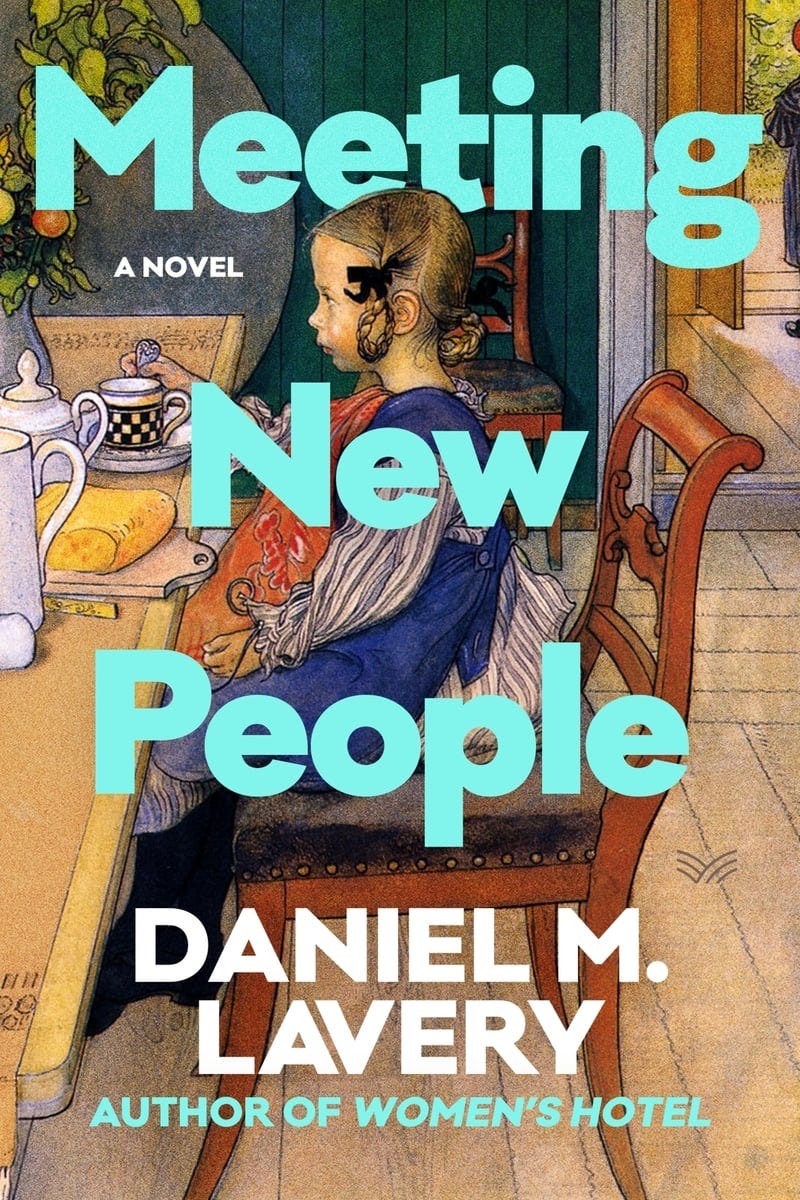
I wanted to write a book about the failure of friendships and in particular the panic that can arise in a person who has recently been dumped and realizes that their previously-successful friendship overture strategy is no longer effective. (You can preorder it here, if you like, and it will go properly on sale June 2nd, but if you don’t want to buy it you certainly don’t have to.)
I have spent much of the last six years thinking about the aftermath of failed relationships in the context of family estrangement, but I had no interest in writing a novel about family estrangement. I wanted to write about someone experiencing the same level of alienation and despair over their friends as a regular poster in r/deadbedrooms, someone vulnerable to incel logic outside of a romantic context, someone who is responsible for her own loneliness but who nevertheless doesn’t deserve her loneliness. Or at least who deserves more than her present loneliness. I wanted to examine a different sort of loneliness than my own, which is how I came to write a book about a not-quite-sixty-year-old woman named Barbara who would dislike me very much, if ever we were to meet one another1:
I think almost everyone has a list of friendships that never quite managed to come together for one reason or another. Often it’s situational. Maybe the two of you had an incredible weekend at an out-of-town conference, or summer camp, or group vacation, but because all the shared references and jokes you built up together had nothing to do with your personality back at home, there’s not enough material to graft onto your real life. Or maybe just as you start to get to know each other, she suddenly gets transferred for work somewhere halfway across the country. You both still like each other, but that doesn’t change the fact that you just haven’t been able to invest enough time into the friendship for her to justify taking it with her when she goes. There are a hundred possible reasons. And you might never know exactly which one is responsible for the relationship not taking, because it’s not like when a friendship falls apart after years of closeness. In those cases you can almost always point to some betrayal, some fight or moment of disagreement, even if you didn’t talk much about what was bothering you at the time, and say That’s it, that’s where it all went wrong with us.
Half the time when a friendship looks like it’s going to take and then doesn’t, neither of you ever knows why, because things happened on an almost totally unconscious level. Like with animals—something just didn’t smell right. Your nose said no. Since you’re still mostly at the being-polite stage in those early days, there’s no way for you to say anything about it. You just discreetly back off, and the other one just as discreetly lets you. It’s entirely fair, and there’s no fault to be apportioned out to anyone. Maybe it’s a little crushing, but you get over it, and after a while, it becomes a hazy, pretty memory, the cut being mild and healing quickly. Someone you met only briefly really liked you once. You can’t quite remember what happened afterwards, but she really liked you. Of course, it’s not like that when a real friendship ends.
When you’ve really gotten to know somebody, you earn the right to at least ask why they don’t love you anymore, which is not an especially pleasant right, but it’s still one that most people tend to insist on exercising. I don’t know why. I’ve never heard anyone tell me why they don’t want to be friends anymore and thought, Oh, that makes a lot of sense. Now I feel better, thanks for letting me know. I’ll be on my way.
People sometimes complain that it’s hard to make friends once you’re out of your twenties, but in my experience, the real trouble doesn’t come until the tail end of your forties, or once your kids reach their teenage years, whichever comes first. Back when I was still married with a three-year-old kid, I could have picked up five new friends a day if I’d wanted to. Women with toddlers cruise each other for friendship the way gay men do for anonymous sex. So even if you’ve drifted away from a lot of your college friends, the way I had at that age, you pick up new ones all the time.
This, of course, creates its own problem, which you might not notice for a year or two, where all of your friends have known you for the same amount of time. It’s a little bit like how farmers need to practice crop rotation, otherwise they’ll wear out the soil after a few years. You need friends of a few different vintages if you don’t want to lose them all at once. When my best “mom friend” Sasha got divorced and only had custody of her kids every other week, we pretty much stopped seeing each other, and then our whole friend group fell apart within a few months. Nobody wanted to fall apart, I don’t think. I don’t remember there being any hard feelings, and if I bumped into Sasha on the street tomorrow, I honestly think we’d be happy to see each other, which is more than I can say for a lot of my former best friends, but we just didn’t have a long enough history to make it through a divorce together.
Besides which, I can’t stand friendships based on divorce. You’re always acting like cheerleaders and talking about how great being divorced is and how you only wish you’d done it years ago, but as soon as one of you starts dating someone seriously, she drops off the face of the earth. Not because she doesn’t like you anymore, but because it’s embarrassing: “Remember last month when we said we’d never live with a man again, and that we should all get a house in Florida together when we retire, like on The Golden Girls? Well, meet Rick, and please God let’s just pretend we never said any of those things.”
I was thinking, too, of the Léon Bloy quote (did he say it? If so, where? If you know, please email this theology professor at Abilene Christian University who’s been trying to find a solid attribution for at least two years now), “the only great tragedy in life is not to become a saint.”
I have two very sentimental impulses that are very dear to me, when it comes to my own family of origin; the first is that I imagine killing them every single day, often multiple times a day,2 and the second is that I imagine how happy I would be if ever I learned they had heartily repented of their wrongdoing and changed the course of their lives. Neither of those two fantasies is very likely to happen, and the idea of ever being delivered from these fantasies strikes me as tremendously improbable. Being relieved of the likeliest possible outcomes requires an act of God.
Without getting into the question of whether Barbara does or does not acquire another best friend, I wanted to give her, if not sainthood, at least the ability to recognize a saint when she saw one, and I wanted her to see it through clothes. The old Roman technique for depicting gods in art is called velificatio. I imagine this technique predates halos but I really don’t know. You know someone is a god in ancient Roman art if their clothes billow vigorously about them. I figured the closest equivalent for Barbara would be having strong opinions about the age cutoff for wearing cap sleeves3, and for that opinion to be eventually shaken and for her character to be fundamentally changed as a result.
“It made me ashamed, sometimes, how easily [Redacted] had accepted my changing attitude towards her. She never asked why I stopped to speak to her now, or what made me knock on her door instead of faking phone calls to avoid her. But the shame was light enough, and I felt less of it with each day. It was nothing compared to the relief I felt from no longer having to act badly. That was a joy that did not pall.”
Pym again!
It’s unclear grammatically whether this means I imagine killing them more than once, or whether I imagine, more than once, killing them, and I suppose it’s unclear to me too.
I personally have no opinion on the subject
It’s a really really good time in this world for a sympathetic portrayal of just such a character, and you’re a little bit of a miracle worker for getting us so close to her without getting us scratched, like we readers are divers in a shark cage, but minus the need for bravery and special equipment.
Incidentally, I’m re-reading Women’s Hotel, and it’s still an excellent time in this world for Katherine and Pauline and Ruth and Stephen and the rest. Somehow they comfort and strengthen me a lot, by showing that sometimes being a human is like _this_, flavors and ways of being that are barely ever explored in the Joseph Campbell big-protagonist stories.
I will have to think about charm. I don’t trust my own. It feels dishonest to try to impress someone I want to impress. I can only meet people when we’re washed up or in over our heads together, and it seems I can only use charm as a sort of good deed for cheering up a fellow down-and-out person. One day I do hope to have a friend who drives the big bus, just think of it!
All of which to say, thanks for the hors d’oeuvre and I can’t wait for more Barbara!
As a 60-something woman who has utterly failed to make any new friends since divorcing 5 years ago, I'm going to assume you wrote this book just for me and plan to enjoy every minute of reading it.