

Meeting New People, my latest novel, features a woman named Barbara caught off-guard by an unexpected breakup with her best friend Susan, which Barbara handles rather badly. One of her greatest missteps comes in the immediate aftermath of getting dumped, when she fails to employ proper gamesmanship1 while speaking to some of the friends she and Susan had held in common.2
On the subject of retaining non-mutual friends after a friendship breakup we have very little to say. Do your best not to complain too often about the breakup, for if you develop a reputation as a grumbler, a grudge-holder, or a score-settler, you may see some of them begin to drift off, but this holds true the rest of the time, anyhow. Remember, however, the unfortunate social truth that nothing breeds failure like failure. Once you begin to give off the stink of someone who is unlucky in friendship, who does not have the happiness of retaining loyalty in others, you will find it does not wash off easily or quickly. Others may begin to look for a reason to cut you loose. If you do not provide them with one, they may invent one anyways.
The act of retaining more mutual friends than one’s former friend requires a very careful touch. One must behave shrewdly at every moment, while all the time appearing to behave naturally, as one moved solely by instinct. The lack of self-consciousness3 must be both perfect and complete. You will be beset by danger on every side. To fail to behave convincingly even once may spell the ruin of the entire project; as Christ says to his disciples in Matthew 10:16, be ye cunning as serpents, and yet harmless as doves.
The Chatner has most recently covered gamesmanship in respect to transitioning by family committee, addressing popular games such as Did Everyone Sign the Card?, All Of A Sudden You’re Mother’s Darling, But I Was Going To Run Errands Today, When Were You Going To Tell Us?, and Old As The Hills:
Let Me Save You Some Time: A Field Guide To Avoiding Transition By Family Committee

Over the years in my various capacities as an advice columnist and trans person who knows other trans people I’ve had repeat encounters with a family dynamic I call “Just To Be Safe, Let’s Transition By Committee.” No one family will contain every type listed below or role-play all of these scenarios, however, the presence of one scenario or type is a s…
Barbara is in an especially tricky position because she cannot claim the moral high ground in her breakup with Susan. Susan established a strong lead over Barbara from the very beginning of their final fight:
She initiated the breakup
She got her claims in writing
She established her side of the story with mutual friends first
A better gameswoman in Barbara’s case might have chosen to
Brazen it out — Kay might have respected Barbara more had she chosen never to broach the subject at all.
Approach Kay in person, and more directly (this would have required extraordinary levels of cunning, however, as engineering a plausibly accidental in-person meeting after a known dumping is extremely unlikely)
Split the difference: made an attractive offer like, “I’m not going to discuss this with you, and I’ll never ask you to discuss it with me,” which goes over well with a certain type of person who dislikes conflict to such a degree that they will prioritize whichever member of the friendship breakup promises a smoother ride in the aftermath, regardless of how they might have otherwise apportioned blame)
It is not necessary (indeed it can sometimes be a hindrance) to have the moral high ground in a friendship breakup. People will feel obligated to assure you of your rightness, but this very obligation may set the groundwork enabling them to decamp for the other side; when it comes to social ties, “who seems more fun/less work for me” often wins out over “who seems right.”
Above all else you must never say “Of course I don’t expect you to choose sides.” You must give off the impression that you believe this (even though of course you are angling for everyone to choose sides, and for your side to win), but you must never say it. (Because if you said it, it would only imply that part of you did feel as though other people ought to choose sides, and that you had the right to release them from such an expectation. The “look who thinks he’s nothing” problem.)
You can see for yourself where Barbara begins to go wrong in her approach:
Come to think of it, I couldn’t remember the last time Kay and I had gone on a walk together…Kay and Susan had been friends for years before I came into the picture, too.
It would be no use calling Kay now, not so freshly and transparently in the aftermath of a breakup. Sounding innocent would be impossible, to say nothing of sounding casual, and I started to worry I was going to have to leave a message (has anyone ever left a message where they didn’t sound guilty of something?). I had just resigned myself to it, in fact, when she suddenly answered after the fifth ring:
“Hello?”
“Hello—Kay?—I was just about to leave you a voice message—”
“Oh?”
“I had just been thinking to myself how nice it’s been lately, how uncharacteristically nice really, and that we really are overdue for a good brisk walk. I know I am.”
“I’m not in town.”
“Oh! You’re out of town? Somewhere nice, I hope.”
This was bad, and getting worse. Short, clipped answers, plus she was going on trips without telling me, or worse, lying to avoid seeing me. Did this call for a change in tactics, or was it safer to continue to pretend ignorance?
“Anywhere nice? I mean, are you anywhere nice?”
“So I won’t be able to go walking with you.”
Damn! Might as well go for broke.
“Kay, I hope you don’t mind my saying so, but it sounds like you may have talked to Susan recently—”
“I talk to Susan often. We talk all the time.”
“Then I’m sure she’s already told you about our fight the other day. And I don’t want you to feel like this puts you in the middle of anything. As far as I’m concerned, I don’t think this has to affect our friendship.”
“Don’t you? I can see why it would.”
Then there was an awful silence for a while. I thought she was going to say more on the subject, since it sounded like a prelude to something, but apparently she thought it was more than enough, because all I could hear was the occasional faint sound of breathing on the other line.
“Well, I don’t expect you to take sides, is all I meant,” I said.
“I’m perfectly happy to take Susan’s side,” she said. “I think you’ve acted really disgracefully.”
As in all acts of gamesmanship, the only rule is to break the flow of your opponent’s play. If your opponent behaves messily, you must appear respectful, forbearing, possibly even as though you are harboring a profound secret that would change the opinion of all who knew you both, but that you will never share due to deeply-held principles, etc. If, on the other hand, your opponent appears to take the high road, you go ahead and share confidances, make digs, and generally go racketing in the direction of pleasure.
If your opponent attempts to analyze your character with others to your discredit, and this information makes it back to you, do not attempt to do the same: a well-timed, slightly world-weary, “Ah. I’m sorry to hear he ended up doing that after all. I wish he might have spared you that at least,” will do nicely. Appearing to have anticipated their every move will always serve you well.
Or if she continues to complain about your bad behavior (even if your behavior has been very bad indeed, you need not despair) to others, and these complaints make it back to you, never complain about her complaints, or attempt to counter with complaints of your own: Say instead that “I do think it’s hard for people, when two of their friends break up, and they feel roped into hearing all of the messy details, or in getting involved. I won’t ask you to do that.”
People may bristle when they hear the expression “choosing sides,” because it sounds presumptuous, but they delight in being told you don’t want them to have to “get involved,” particularly if you are dealing with the conflict-avoidant. You may have killed someone, but promise that you’ll never require them to “get involved” and they’ll still end up taking your part nine times out of ten.
I wrote a book about friendship breakups, so I interviewed a bunch of my friends about their friendship breakups

I have a new novel coming out in three weeks in which the narrator is unexpectedly dumped in her living room by her best friend in the middle of making dinner. She does not handle it well. I do not have much in common with her, but I do share her habit of believing I am acting with great dignity when I am in fact making a real spectacle of myself.
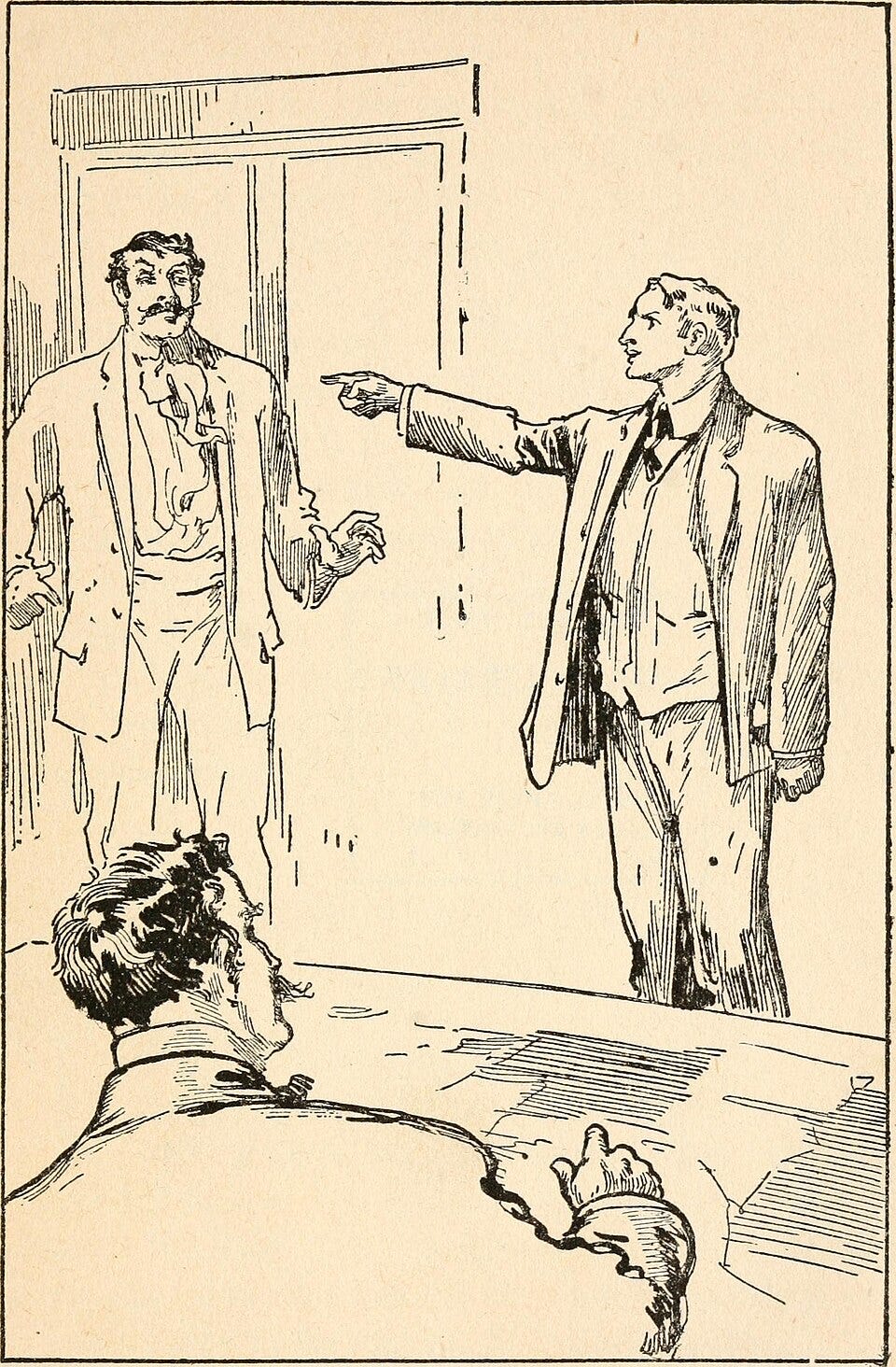
[Image via]
_(14772759243).jpg)
That is, the art of winning without actually cheating.
Assume that whenever The Chatner discusses social gamesmanship that the claims you are reading is perhaps 50% exaggerated. And I think it’s better to err on the side of doveishness, you know, rather than serpency, but for all that I think the dove part of one’s brain ought to retain some idea of what the serpent side is thinking.
You need not pretend to innocence; you will in fact likely fare better if you make no claims in that direction, either implicitly or explicitly. But you must appear unself-conscious. If you seem at all conscious that you are performing for an audience, you will lose them.
I loved this book, even though I am the exact same age as Barbara and I kept thinking she was *old* old, like 80 years old. In my experience, people my age think of themselves as middle-aged (not old), even though that implies a nearly impossible lifespan. We're Gen X, not Boomers! But I totally believed in Barbara anyway and would happily have read 300 more pages about her.
This book of yours is my favorite book I’ve read in ages and I just had to tell you!! 🥰